

[Yamagata, Tendo City] Hiroshige Museum of Art where you can appreciate Gassan swords|Japanese swords and blades with beautifully patterned grain
2026/02/04 This site contains advertisements. Category: traditional-crafts
![[Yamagata, Tendo City] Hiroshige Museum of Art where you can appreciate Gassan swords|Japanese swords and blades with beautifully patterned grain アイキャッチ](https://bongheiberg.yamagata.jp/wp-content/uploads/2026/01/IMG_8810-EDIT-scaled.jpg)
At the Hiroshige Museum of Art, located in the hot spring town of Tendo City, Yamagata Prefecture, you can closely appreciate the works of ukiyo-e artist Utagawa Hiroshige along with Yamagata’s proud famous swords, the Gassan swords. Even if you are not familiar with Japanese swords, their beauty makes you want to stop and take a closer look.
The Gassan swords, known for their unique blade pattern called “Ayasugi-hada,” have been passed down for over 800 years since the Kamakura period and are recognized as a distinguished lineage (school) of Japanese swords.
In this article, we will clearly introduce the attractions and history of the Gassan swords that you can encounter at the Hiroshige Museum of Art, along with highlights that even sword beginners can enjoy.
Do swords have names? Highlights of Japanese swords that beginners can understand
Sword exhibitions seem kind of difficult… I think there are probably quite a few people who feel that way. One of the reasons might be the abundance of technical terms for the sword itself and its descriptions, as well as the many kanji characters whose readings are unclear.
‘Who made this sword, and in which era?’
When you look at the caption boards introducing the works with that thought, you’ll find a line-up of names you rarely see or kanji that you don’t know how to read. Just seeing that can be a bit intimidating, right?
However, in fact, appreciating Japanese swords can be thoroughly enjoyed even without understanding everything.
So this time, I will clearly introduce for beginners two points that, if you know them, will make visiting a Japanese sword exhibition and appreciating Japanese swords 100 times more interesting.
Each Japanese Sword Has a Name | The Name of the Gassan Sword
First of all, those seeing a sword for the first time will probably be surprised that swords have names.
Swords are named based on the creator’s name, style, historical background, or anecdotes such as what the sword cut.
The “Gassan sword” introduced this time mainly refers to the sword known for the inscriptions called “mei” engraved by the maker on the blade, and the pattern of the sword called “ayasugihada.”
Characteristics of Gassan Swords | Mei and Ayasugihada
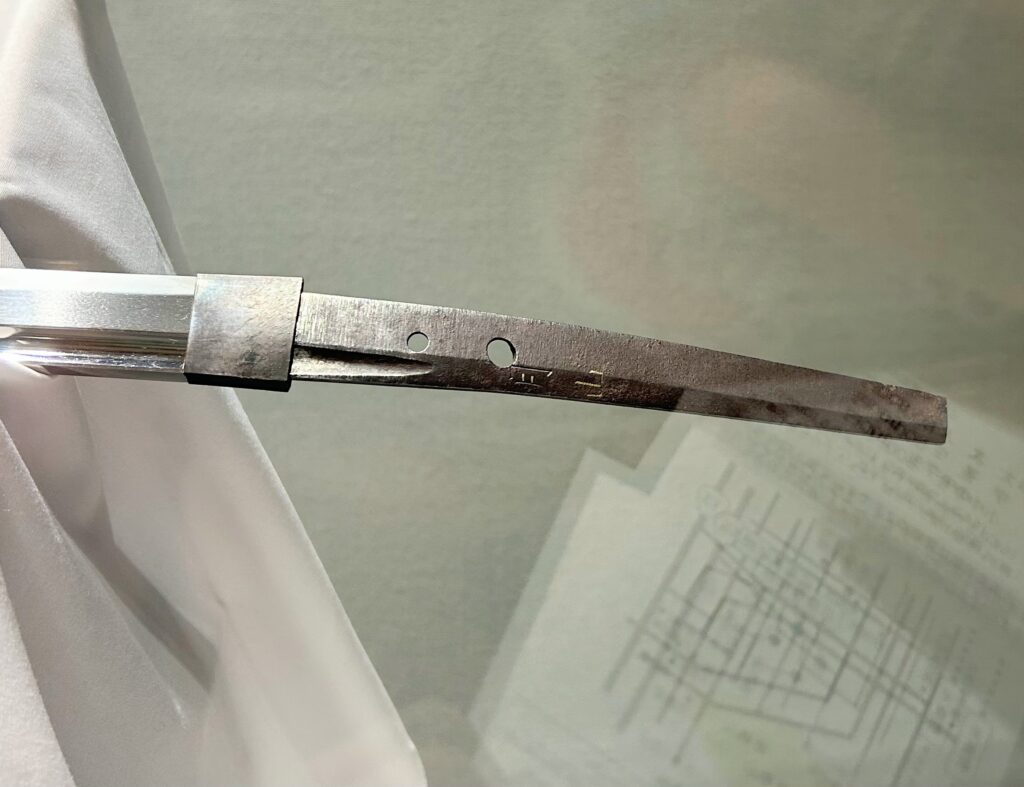
When looking at a Gassan sword, you can see that the name and year are engraved at the base of the blade. In sword terminology, this is called a ‘mei,’ and it serves as an indicator of when and by whom the sword was made. A Gassan sword is basically one that has a mei engraved with ‘Gassan’ on the tang, and the term is used to refer to the style of the Gassan school, which is characterized by the ayasugi-hada pattern.
In addition, one of the characteristics of Gassan swords is a pattern on the blade called “Ayasugi-hada.” In sword terminology, this pattern is known as “Kitae-hada” and it is created by repeatedly folding the steel used for the sword’s base and forging it with a small hammer. Generally, there are various types such as Itame-hada and Masame-hada, but the “Ayasugi-hada” of Gassan swords is known as a unique pattern that can only be reproduced by the swordsmiths of Gassan.
The Charm of “Gassan Swords” Continuing Since the Kamakura Period
Mount Gassan is a famous mountain of the Dewa Sanzan Shugendo that developed since the Heian period, and it is recorded in the Kanchiin-bon (one of Japan’s oldest sword books) that swordsmiths engraved the name of this Mount Gassan on their swords, a practice that existed since the Heian period.
The Beginning of Gassan Swords

The Gassan school of swordsmiths, active from the early Kamakura period to the Muromachi period, flourished at the foot of Mount Gassan in Oshu, with the main production areas believed to be Sagae and Yachi in the eastern foothills of Mount Gassan.
The founder of the Gassan swordsmiths is said to be Kiohmaru, who lived at the sacred site of Mount Gassan in Dewa Province.
The peak of their activity is considered to have been during the Nanboku-chō period, and the oldest confirmed existing sword is the “Tachi with the Gassan Two-Character Inscription” (an Important Art Object, held at the Dewasanzan Shrine).
The “Tachi with the Gassan Two-Character Inscription” (the meaning of the name is that it is a tachi by a Gassan swordsmith, with the two characters for Gassan inscribed near the base of the blade).
A major characteristic of Gassan swordsmiths’ style is a unique forging method called “Ayasugi-hada.”
A sword is made by repeatedly folding and hammering the steel with a small hammer, and this forging method brings out the beautiful pattern of the Japanese sword known as “Kitae-hada.” Common types of “Kitae-hada” in the sword world include Itame-hada and Masame-hada, but “Ayasugi-hada” is a special grain pattern that does not belong to any of these, and for this reason, it is also called “Gassan-hada.”
From the early Kamakura period to the Nanboku-chō period and the late Muromachi period, Gassan swords spread throughout Japan for their high practicality as blades and the beauty of their unique patterns called “Ayasugi-hada.” The early works of Gassan swords are classified as “Kogassan.” At the Hiroshige Museum of Art, you can actually see a sword titled “Koto Gassan (Ayasugi-hada), made around the Muromachi period.”
Gassan Sadayoshi, who studied under Suishinshi Masahide, and the Revival of the Osaka Gassan School
Entering the Edo period, Gassan swords once declined as wars came to an end.
Amid this, Gassan Sadayoshi, who strived for the revival of Gassan swords, around the 4th year of Tenpō (late Edo period), learned techniques from Suishinshi Masahide, who had been advocating the revival of old swords in Edo and was originally from what is now Kahoku Town in Yamagata Prefecture.
Suishinshi Masahide was also one of the swordsmiths who honed his sword-making skills in Yamagata, and in the warless Edo period, he was struggling to revive swords suited for practical use. Since traditional Gassan swords were used for practical purposes during wartime, he may have been an indispensable key person in the revival of Gassan swords.
Afterwards, Sada Kichi Tsukiyama moved to Yariyamachi in Osaka, revived the ancestral Ayasugi forging technique, and established the Osaka Tsukiyama School, which continues from the Meiji era to the present day. In other words, the birth of the Osaka Tsukiyama School can be said to be an important turning point in connecting the techniques of the old Tsukiyama to the modern era.
The Tsukiyama Sword Seen by Matsuo Basho|Evaluation Recorded in ‘Oku no Hosomichi’
Even as the skill of Tsukiyama swords declined during the Edo period, the evaluation of Tsukiyama swords themselves was reportedly quite high. As evidence of this, there is a description of Tsukiyama swords in Matsuo Basho’s ‘Oku no Hosomichi.’
『The blacksmiths of this country (Oshu) selected sacred water and purified their minds and bodies there to forge swords. Eventually, the swords were inscribed with the name “Gassan,” becoming highly renowned in the world.』
(Modern translation)
From this description, it can be seen that by the Edo period, Gassan swords were already widely known as famous blades. Moreover, since it is recorded that people from Haguro toured the forge around Gassan, it is clear that, even then, Gassan swords had already attracted public interest.
Gassan Swords Continuing to the Present
Over the course of four generations, it has been handed down, and today, new swords are being created based in Nara Prefecture.
Gassan swords have survived difficult times, such as the Meiji-era Abolition of Swords Ordinance and the post-World War II Weapons Manufacturing Ban, leaving behind many masterpieces. In addition, the high level of skill and achievements, along with the swordsmithing techniques of Gassan swords preserved and passed down from ancestors, have been highly regarded. From the Gassan swordsmiths, Gassan Sadaichi (the second generation) was recognized as a holder of Important Intangible Cultural Property (Living National Treasure).
At the Gassan Japanese Sword Forging Dojo in Sakurai City, Nara Prefecture, new swords are created every day. In addition, at the Gassan Memorial Hall attached to the forging dojo, visitors can trace the history of swordsmith Gassan and view works by successive Gassan swordsmiths, from ancient Gassan swords to Living National Treasure Gassan Sadaichi (the second generation), Gassan Sadatoshi, and Gassan Sadanobu.
Gassan Swords You Can Encounter in the Tendo Hot Spring Town
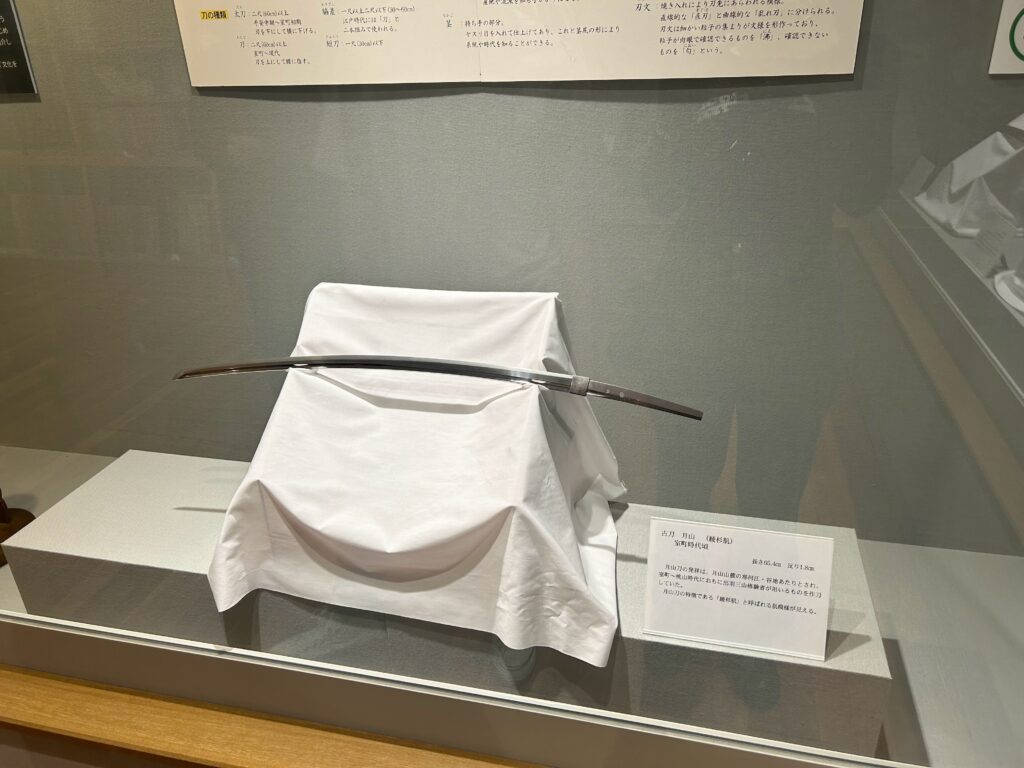
You can actually closely admire the highly prestigious Gassan swords in a corner of the Tendo Onsen area.
Near the hot spring town in Tendo City, Yamagata Prefecture, there is the Hiroshige Museum, known for the works of the ukiyo-e artist Utagawa Hiroshige. Inside the museum, in addition to ukiyo-e works, the production process and techniques are also introduced.
After passing through the stained glass hall of the Hiroshige Museum and ascending the staircase where characters from Hiroshige’s works welcome you, you will reach the museum reception.
Right next to the reception of the Hiroshige Museum, there is a section exhibiting “Gassan swords” born at the foot of Mount Gassan in Yamagata and warrior pictures by late Edo-period ukiyo-e artists. There, you can experience the bold yet refined Japanese samurai culture while admiring the beautiful Gassan swords.
From the Early Period to the End of the Muromachi Period|The Origins and Early Works of Gassan Swords
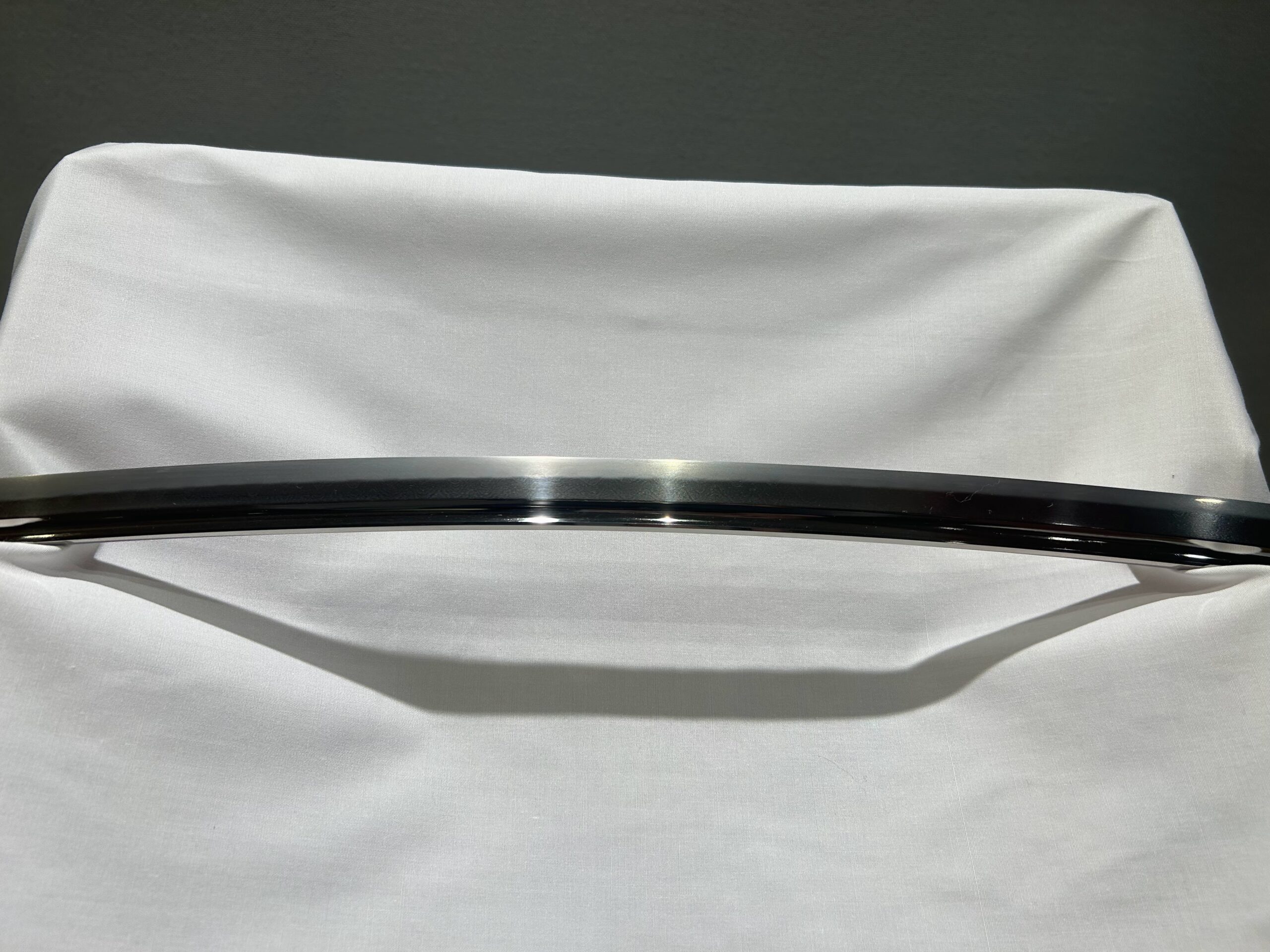
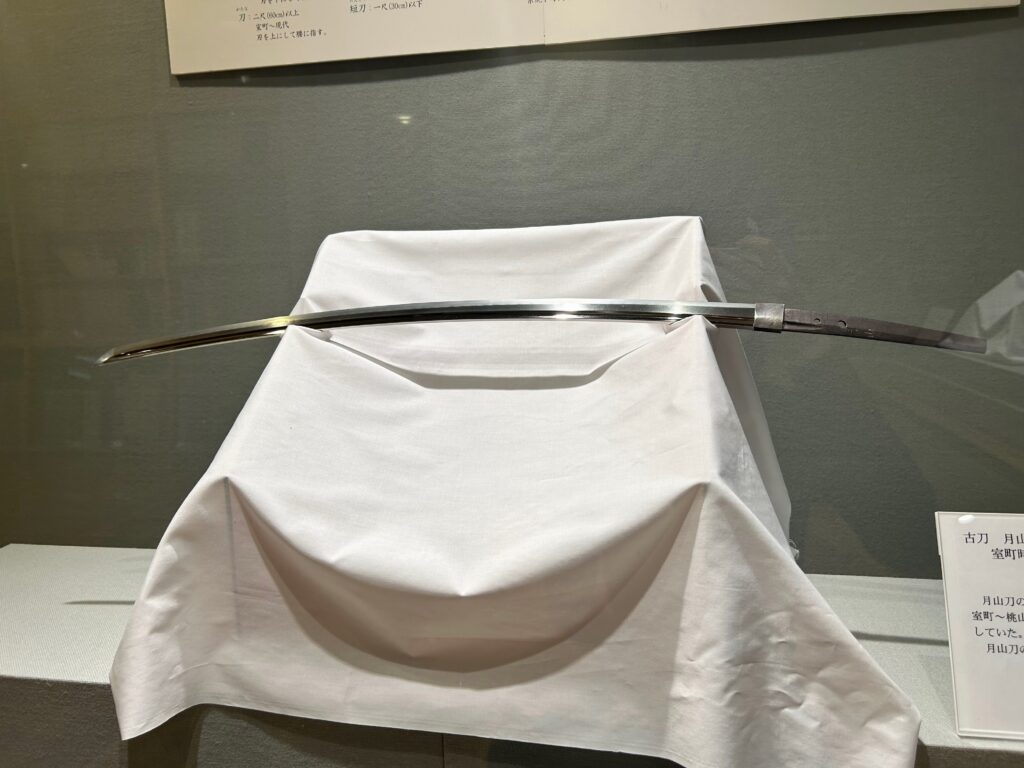
The first thing that catches your eye in the exhibition corner is the ‘Koto Gassan (Ayasugi-hada)’, which shines particularly in its single display.
It is a work from the Muromachi period and is a practical sword designed for fighting while riding a horse. The curvature of the sword is made fairly pronounced so that it can be drawn easily while mounted on a horse. Whether this sword was actually used on the battlefield is uncertain, as there are no records to confirm it. Even so, I was deeply impressed that a work from around 800 years ago has been preserved in such a beautiful condition.
You could also see the characteristic ‘Ayasugi-hada’ of Gassan swords. This is the area at the boundary between the blade and the ridge. The forged texture (black part of the sword) is neatly divided straight from the edge of the blade, with patterns layered like the grain of cedar.
It is a bit difficult to see in the photos, so be sure to see the ‘Ayasugi-hada’ pattern in person.
Edo Period to Present | Works of the Osaka Gassan School and Living National Treasures
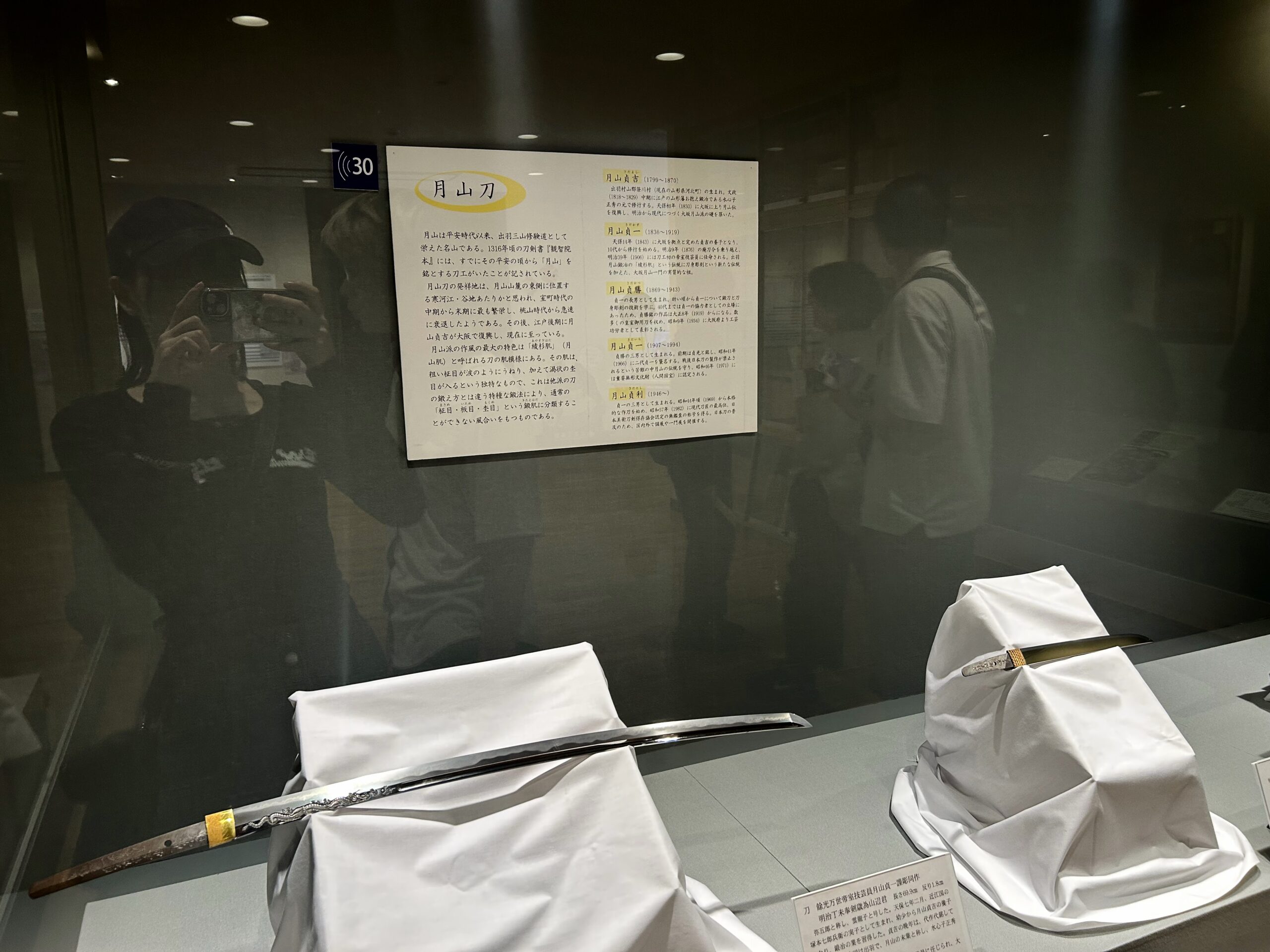
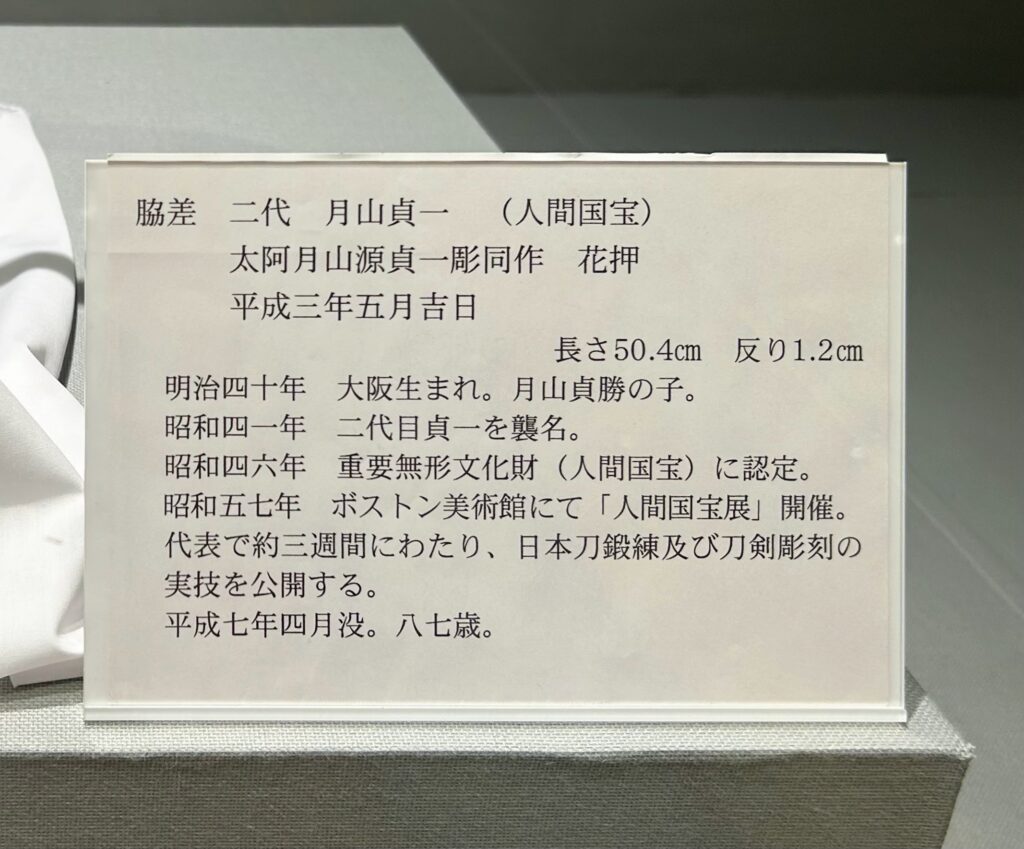
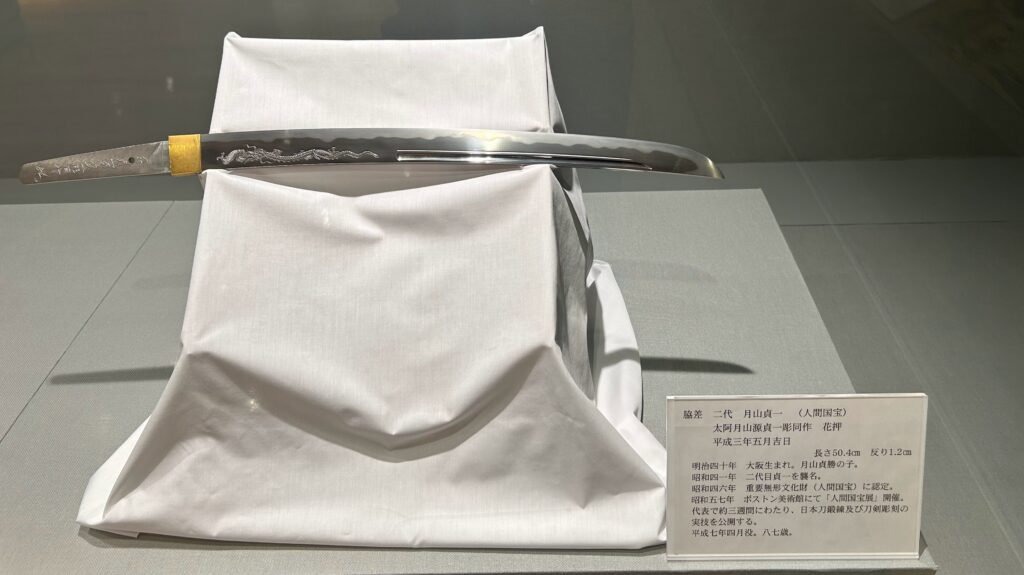
Only two swords appear in the photo, but further inside, another wakizashi made by Living National Treasure Tsukiyama Sadakazu (second generation) is on display. In the display case next to “Koto Tsukiyama (Ayasugi-hada),” three works by successive generations of Tsukiyama swordsmiths were lined up.
From the left side of the display, there are works of the Osaka Tsukiyama school after the revival of Tsukiyama swords, created by the first generation Tsukiyama Sadakazu.
「刀 餘光万世帝室技芸員 月山貞一謹作彫同作 明治丁未奉剣歳為山辺君」
(餘光万世(よこうばんせい) 帝室技芸員(ていしつぎげいいん) 月山貞一(がっさんさだかず) 謹作(きんさく) 明治丁未(めいじひのとひつじ / めいじていび)奉剣(ほうけん)歳為山辺君(としやまのべきみのため)
At first glance, the string of kanji may cause a moment’s hesitation in reading, but to put it simply, it means: ‘This is a sword whose brilliance and craftsmanship are meant to last for eternity. It was carefully engraved (the carvings) by Teiichi Gassan, an Imperial Household Artist, who also made the sword itself. In the 40th year of the Meiji era, it was a specially made sword presented to a person named Yamabe.’
「餘光万世帝室技芸員 月山貞一謹作彫同作 明治丁未奉剣歳為山辺君」The fact that these 29 kanji characters are engraved within the limited area at the base of the sword is also a part where the swordsmith’s skill shines.
To the right of the central showcase, there is an exhibition of warrior prints by Ukiyo-e artists from the late Edo period.
Ukiyo-e and Japanese swords are closely related. Many tsuba (sword guards), which are the handle parts of swords, are based on Ukiyo-e designs, and Ukiyo-e often depicts warriors in battles, naturally featuring many famous swords.
Access & Basic Information
The Hiroshige Museum is a 10-minute walk from JR Tendo Station and a 15-minute drive from Yamagata-Kita IC on the Tohoku Chuo Expressway. Parking is available, but the number of spaces is limited, so it is advisable to check nearby affiliated hot spring parking lots as well.
For public transportation, it is recommended to take a bus from JR Tendo Station.
| Spot Name | Hiroshige Museum of Art | |
|---|---|---|
| Phone Number | 023-654-6555 | |
| Opening Hours | 10:00 AM – 5:00 PM (last admission at 4:30 PM) | |
| Closed | Tuesdays During exhibition changes (please check the exhibition schedule on the official website) |
|
| Address | 1-2-1 Kamata Honcho, Tendo City, Yamagata Prefecture, 984-0025 | |
| Access | 10 minutes on foot from JR Tendo Station 15 minutes by car from Tohoku-Chuo Expressway Yamagata-Kita IC Get off at Tendo Onsen from in front of JR Tendo Station, travel time 5 minutes |
|
| Parking | Available (4 spaces in front, 9 on the east side, 7 on the west side) If full, please use Takino-yu Large Parking Lot (3-minute walk) |
|
| Admission Fee | Adults: 800 yen Students: 500 yen Elementary and junior high school students: 300 yen – Group discount for 15 or more people (100 yen off per person) – Half price for the person with a disability certificate and one accompanying person |
|
| Official HP・SNS | Hiroshige Museum of Art HP Hiroshige Museum of Art Instagram Hiroshige Museum of Art Facebook Hiroshige Museum of Art X(旧Twitter) |
Summary
The Gassan sword is a crystallization of Japanese sword culture, nurtured at the foot of Mount Gassan in Yamagata Prefecture and handed down for over 800 years.
At the Hiroshige Museum of Art in the Tendo hot spring area, you can appreciate everything from the history of the Gassan sword to the works of living national treasures at once, allowing a wide range of people, from beginners of Japanese swords to sword enthusiasts, to enjoy.
Why not experience the beauty and romance of Yamagata’s proud masterpiece, the “Gassan sword,” as a stop during a hot spring trip or sightseeing in Tendo?

![[Yamagata, Obanazawa City] Torimotsu Chuka Soba Yamahachi Kinsuke|Why Even Non-Ramen Lovers Visit アイキャッチ](https://bongheiberg.yamagata.jp/wp-content/uploads/2026/01/202602231539071-1.jpg)
![[Yamagata, Sagae City] Popular souvenir “Yamitsuki Shimikarisen” really impossible to buy? アイキャッチ](https://bongheiberg.yamagata.jp/wp-content/uploads/2026/01/20260223153907_40.jpg)
![[Tendo City, Yamagata] Menya Imajin Leap|A Popular Ramen Shop! Fish-based miso Broth アイキャッチ](https://bongheiberg.yamagata.jp/wp-content/uploads/2025/09/20260223155236-20260223155236leap1.png)