

[Yamagata, Tendo City] Sanpoji Temple, the Oda Family’s Ancestral Temple | The portraits of Oda Nobunaga
2025/11/13 This site contains advertisements. Category: visit to a shrine or temple
![[Yamagata, Tendo City] Sanpoji Temple, the Oda Family’s Ancestral Temple | The portraits of Oda Nobunaga アイキャッチ](https://bongheiberg.yamagata.jp/wp-content/uploads/2025/11/20260223155236_202602231552361_90.jpg)
In Tendo City, there is a Kenkun Shrine dedicated to Oda Nobunaga as the enshrined deity. I heard from the chief priest of Kenkun Shrine that “Sanpo-ji” in Tendo City is the family temple of the Oda clan, and every year around the anniversary of the Honnoji Incident (June 2 on the lunar calendar), descendants of the Oda family and related individuals gather there for memorial services. It is also said that there is a photograph of Oda Nobunaga’s portrait, which is used in the Kenkun Shrine pamphlet. This time, we will report on what kind of temple the family temple of the Oda clan is and what Oda Nobunaga’s portrait looks like, through the story and photos provided by the head priest of Sanpo-ji!
What Is the Oda Family’s Connection? Unveiling the History of Sanpō-ji Temple
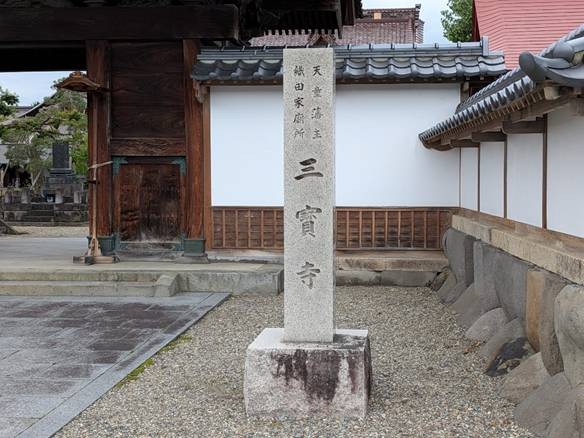
Sanpō-ji is a Jōdo sect temple located in 1-chome, Nakachō, Tendō City, and it is situated close to Kenkun Shrine, which is dedicated to Oda Nobunaga. In front of the main gate, there is a stone monument firmly engraved with ‘Tomb of the Oda Clan, Lord of Tendō Domain.’
The Tendō Oda Domain was founded by descendants of Oda Nobukatsu, the second son of Oda Nobunaga. Although the family fell from the ranks of powerful feudal lords due to conflicts with Toyotomi Hideyoshi, they survived as a small domain, moving from Obata Domain in Kanra Town, Gunma Prefecture, to Takahata Domain in Takahata Town, Yamagata Prefecture. In the 13th year of the Bunsei era (1830), Oda Nobutomi established the Tendō Domain.
In the same year, Sanpou-ji Temple was designated by the shogunate’s temple and shrine administration as the family temple of the Oda family, and since then it has served as the family temple within the domain. So it has been their family temple for about 200 years.
As a side note, before Sanpou-ji became the family temple, Soufuku-ji Temple (in Kanra Town, Gunma Prefecture) served as the family temple for the Oda family of the Obata Domain, and even now there are tombstones from Oda Nobukatsu to the seventh generation.
Report on Visiting the Sanpou-ji Main Hall | Valuable Stories from the Head Priest
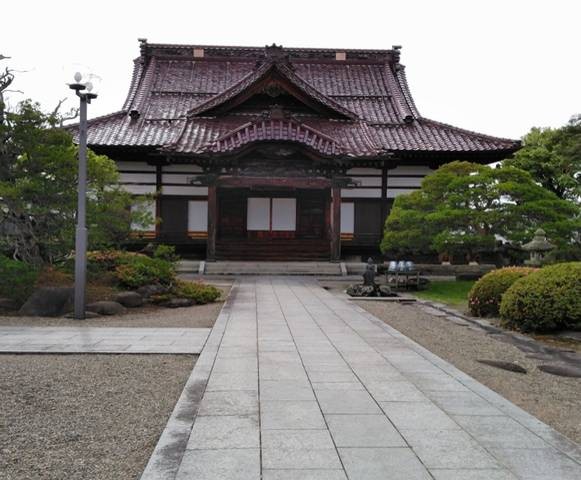
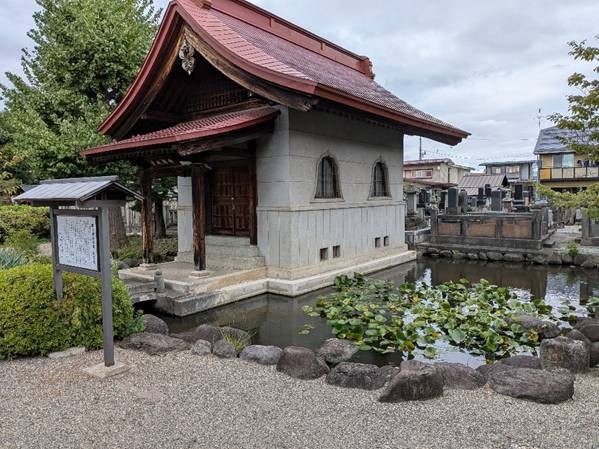
When you pass through the temple gate, the main hall is directly in front, and to the right, there is a spirit house (memorial hall for ancestral tablets) and a beautiful pond where koi swim.
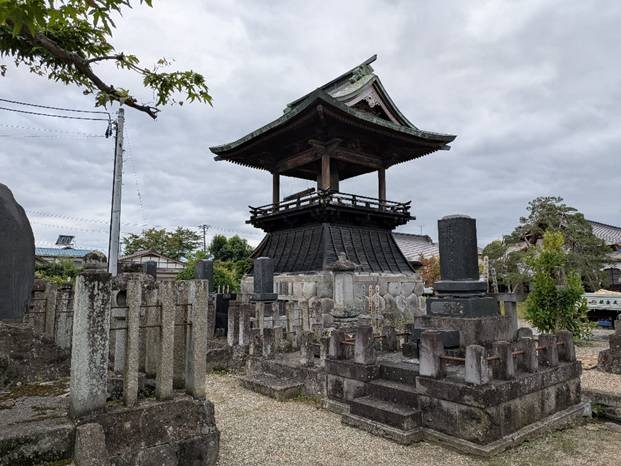
On the left-hand side, there is a magnificent bell tower, and it seems that the bell is struck during events and at the New Year.
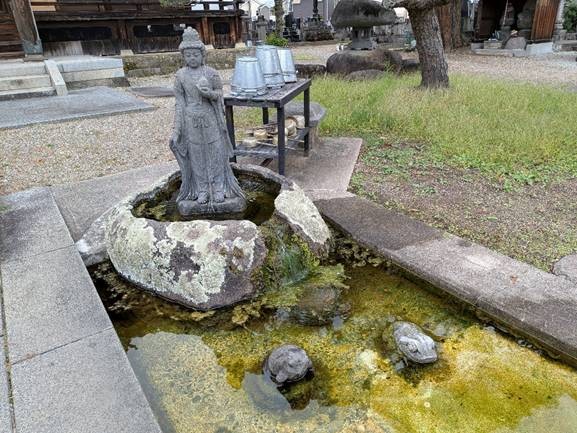
The temizuya (water pavilion) is located in front of the main hall. It seems this is where you draw water to offer at the graves.
It’s very charming and lovely.
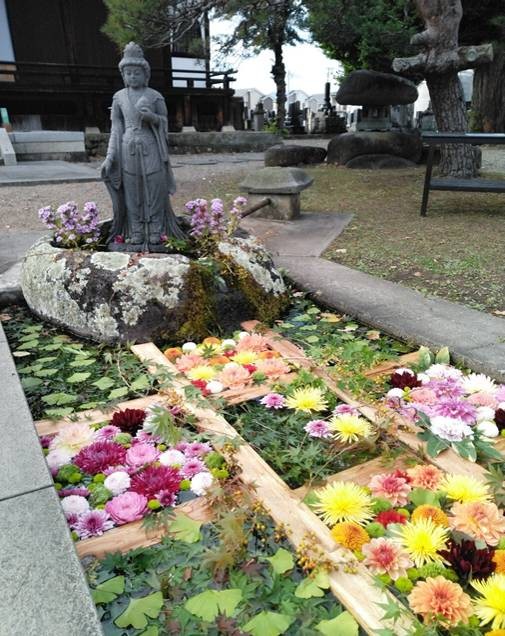
By the way, the photo below was taken at a temple event a few years ago. It was really beautiful!
We’re finally at the main hall.
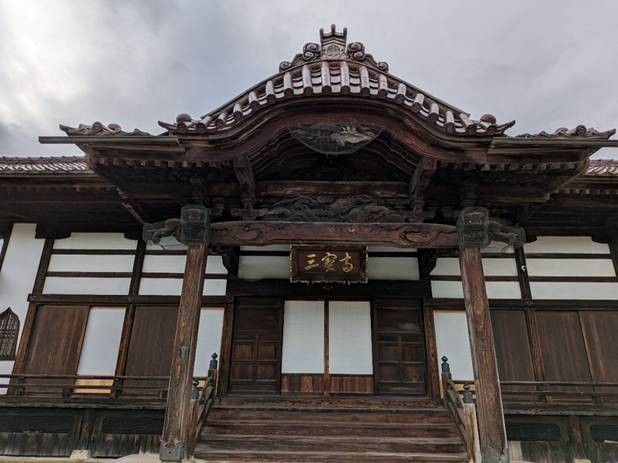
Usually, the main hall doors are closed like this, but you can enter through the door with the shoe rack on the left, and if you speak to the head priest in the building on the left, you can go up to the main hall to pay your respects.
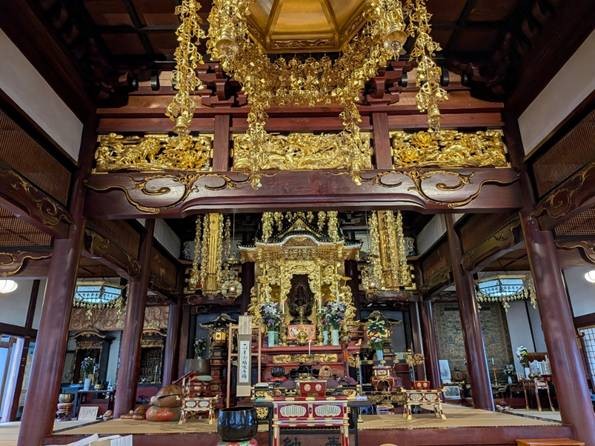
Inside the very splendid altar, Amida Nyorai was enshrined. According to the head priest’s story, this gold-leafed pedestal was a long-cherished wish of the previous head priest, who passed away after seeing it fulfilled. I felt deeply grateful as I visited, imagining the immeasurable dedication and effort that must have gone into it.
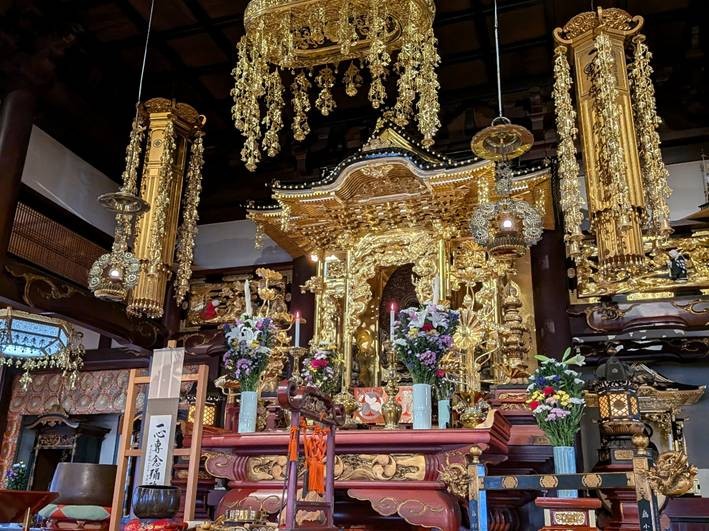
When I asked the chief priest if I could take a photo, he kindly took the trouble to light a candle for me! In the back right of this main hall, a portrait (photograph) of Oda Nobunaga is displayed.
Finally, Face-to-Face with the Portrait of Oda Nobunaga!
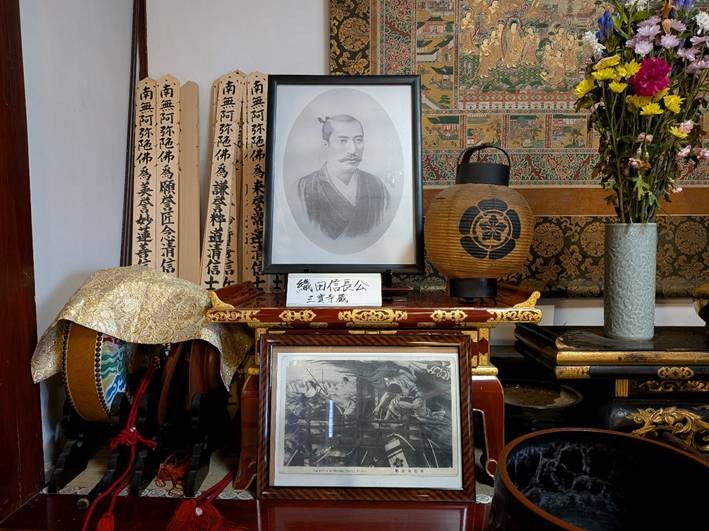
If you go to the back right of the main hall, you will immediately notice a portrait of Nobunaga. This portrait is said to have been painted by a missionary during Nobunaga’s lifetime. Since the original has been lost, only photographs of the portrait currently exist.
It is said that this photograph was taken during the Meiji era by the Otake Photo Studio, which was commissioned by the Imperial Household Agency, and copies were presented to the Oda family, the Imperial Household Agency, and Sanpō-ji Temple. The Otake Photo Studio was established by Fumio Otake, a former retainer of the Tendo Oda clan, who became a photographer. The studio was highly successful due to his exceptional skills, and it was designated as a photographer for the Imperial Household Agency.
Currently, the original and two photographs have been lost, and only the one at Sanpō-ji remains.
He’s an incredibly handsome Nobunaga, isn’t he?
At the time the portrait was painted, it was said to resemble Lord Nobunaga very closely in the Oda family, and the retainers would always pay their respects to this portrait when giving their New Year’s greetings.
I wonder if there were many women who fell in love with this handsome Lord Nobunaga.
The only portrait photograph is displayed in the mausoleum, but it is also hung inside the main hall of Sanpō-ji Temple, and you can view it freely if you ask the head priest. The lantern next to it also seems to be from that time. The texture of Nobunaga’s family crest (the Oda Mokko crest) really gives a sense of history.
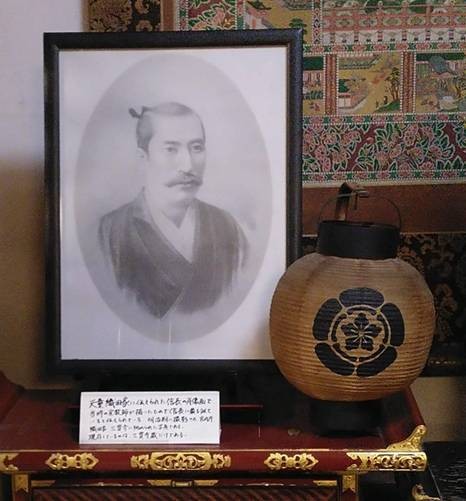
Below this photo, there was also a picture frame like the one in the painting.
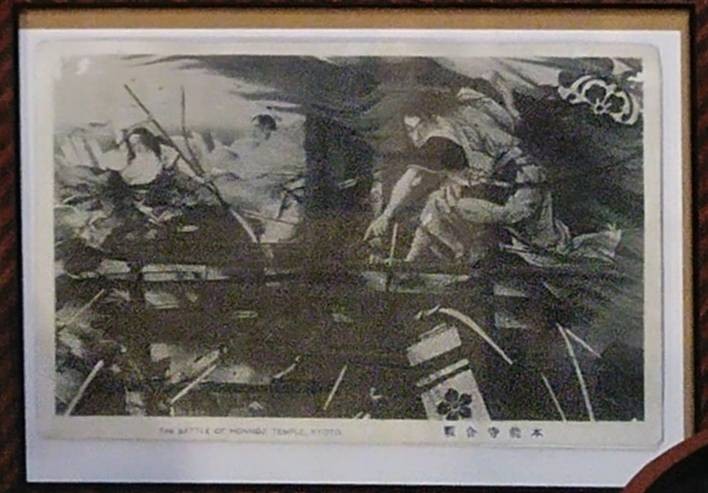
If you look closely, it seems to depict the battle of the ‘Honnō-ji Incident.’ At the bottom of the painting, it is written from right to left as ‘Battle of Honnō-ji.’ The samurai on the right has a flag with the kikkō crest, so that must be Akechi Mitsuhide. The samurai dressed in white, located slightly left of center in the background, is believed to be Oda Nobunaga. This is a must-see piece for Nobunaga fans and history enthusiasts.
If you look closely at this painting of the Incident at Honno-ji, it appears to be a photo of the painting. Nothing is written on the back of this photo, and even the chief priest doesn’t know the details.
We were also granted the special honor of visiting the Oda family’s “Mitamaya” shrine!
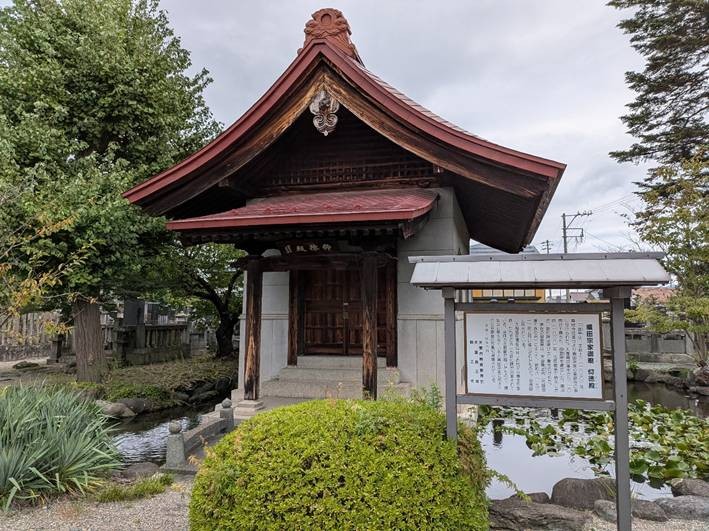
This time, thanks to the kindness of the chief priest, we were able to directly pay our respects to the memorial tablets in the spirit house located on the temple grounds!
This shrine is a spirit house (memorial tablet hall) that enshrines the memorial tablets of 79 successive heads of the Oda family and their relatives, starting with Oda Nobunaga. At the time it was commissioned by their family temple, the Oda family donated twenty ryō to Sanpō-ji to construct the spirit house. It is said that their retainers from Teisen-ji in Takabatake escorted it in procession while guarding it, and it was enshrined in the spirit house.
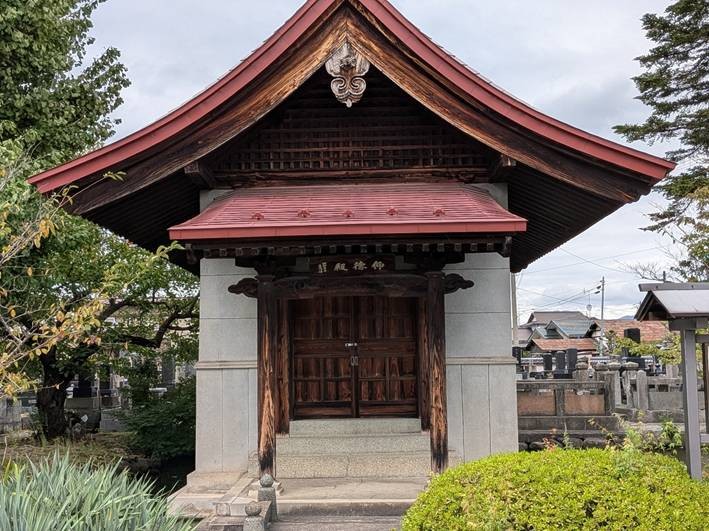
The current spirit house was rebuilt in 1931 by the Association of Former Oda Clan Samurai (Yōseikai) after it was destroyed in the Boshin War, and it is called Gyōtoku-den.
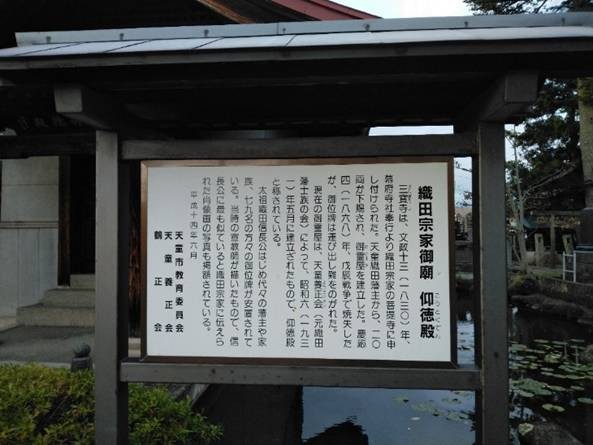
I was really nervous the moment the head priest unlocked the front door and opened it.
At the front of the cozy tatami room, a photograph of the only remaining portrait of Oda Nobunaga was displayed, and behind it, numerous jet-black memorial tablets were enshrined.
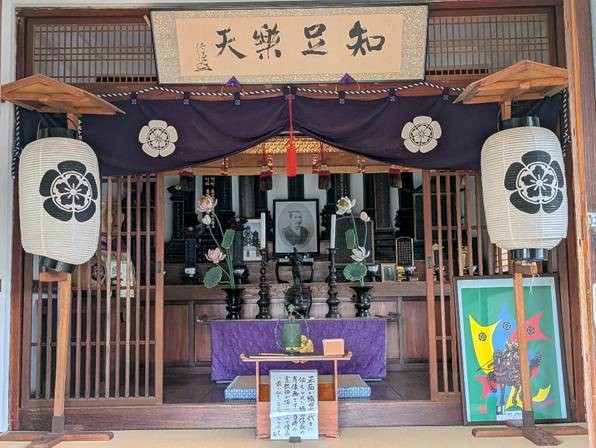
An overwhelmingly large number of ancestral tablets, older than anything I had ever seen, were lined up, and I bowed deeply, almost prostrating myself, overwhelmed by their sheer presence. It felt as if I were sitting before Lord Nobunaga and his retainers.
“Lift your face,” I thought I heard those words, so I raised my head, put my hands together, and offered my prayers.
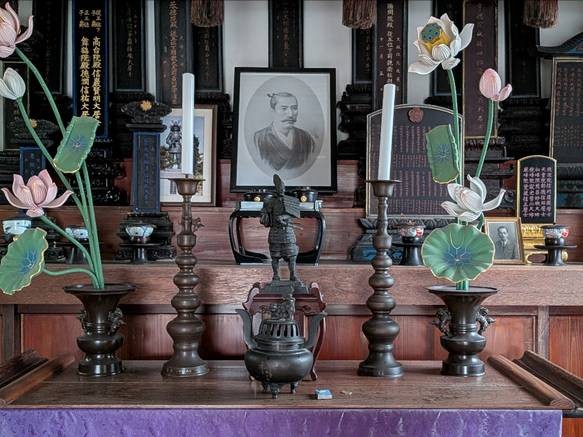
I didn’t hear anything like “Come closer,” but with all due respect, I also took some photos from nearby.
Honestly, I wanted to see each memorial tablet individually, but I was so nervous that I couldn’t really take a proper look.
I later found out that on the back page of the Sanpōji pamphlet placed next to this incense burner stand, the posthumous names of the successive lords of the Tendo Oda Domain, starting with Lord Nobunaga, are written.
It might be fun to look for the lords’ memorial tablets while checking this pamphlet.
However, I think you would be extremely nervous…
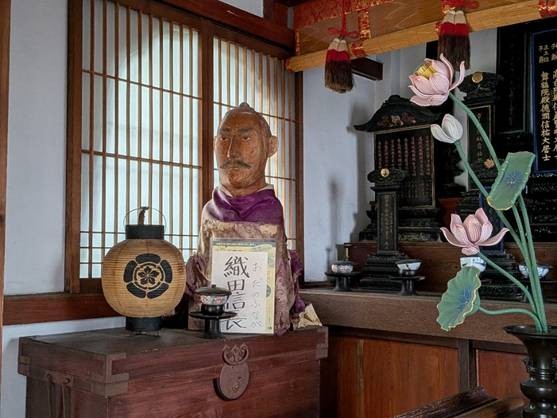
On the left side, there was also a wooden statue of Nobunaga carved like this.
This Goryo (Gyotoku-den) is a wonderful place where, even after many years, you can feel close to those great historical figures, Oda Nobunaga and the Oda clan samurai.
If you are a fan of Nobunaga, I think this is definitely a place you should visit at least once.
*Anyone can pay their respects if they speak with the head priest, but since the priest may not always be present, please contact them in advance.
By the way, it seems that the annual memorial service for Lord Nobunaga is held in this mausoleum.
Is it true that there is a memorial service every year around the time of the Honno-ji Incident?
Having confirmed that Sanpou-ji Temple is the family temple of the Tendo Domain branch of the Oda clan, there was something I really wanted to ask the chief priest.
That is, I wanted to know whether it is true that every year around the time of the Honno-ji Incident (June 2nd in the old calendar), descendants of the Oda family and related parties gather for a memorial service.
I boldly brought it up with the chief priest, and he said, ‘This is often misunderstood, but it’s not people descended from the Oda family themselves, rather those whose ancestors were samurai serving the Tendo Oda Domain, who hold memorial services on the first Sunday of June every year.’
In other words, descendants of the domain samurai who served the Oda family (a samurai association called ‘Yoseikai’) still hold these memorial services today.
It was a bit disappointing that they weren’t directly descendants of the Oda family, but even so, I was deeply impressed that the samurai who served the Oda family over 400 years ago have passed down their loyalty consistently to their own descendants.
Moreover, it’s surprising that the event is held around the anniversary of Oda Nobunaga, the founder of the Oda family. This just goes to show what a truly remarkable general Oda Nobunaga was, earning profound trust from his retainers.
Summary
Sanpō-ji Temple is the family temple of the Oda clan in the Tendo Domain, housing the memorial tablets of Oda Nobunaga and successive heads of the family and their relatives, totaling 79 tablets. Additionally, it preserves the only existing photograph of a portrait of Oda Nobunaga, said to have been painted by a missionary.
Astonishingly, even after more than 400 years, the samurai of the Tendo Oda Domain continue to hold memorial services in honor of Nobunaga, the founder of the Oda family. This dedication exemplifies the very essence of Bushido—the loyalty sworn to their lord.
The head priest of Sanpouji Temple, whom I spoke with this time, was very friendly and shared many stories when I spoke to him. Also, although it is not publicly stated that they offer goshuin (temple stamps), he mentioned that they will write one if you ask.
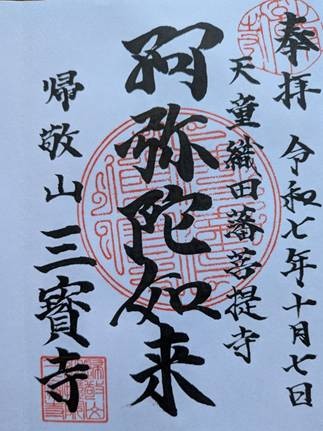
Of course, it’s a must-visit for fans of Nobunaga, but it’s especially recommended for those who love history or have an interest in Sengoku-era generals, so be sure to stop by at least once.
| Spot Name | Sanpō-ji (Sanpou-ji) |
|---|---|
| Phone Number | 023-653-2551 |
| Business Hours | – |
| Closed Days | – |
| Address | 1-2-5 Nakamachi, Tendo City, Yamagata Prefecture, 994-0045 |
| Access | About a 14-minute walk from JR Tendo Station, about 15 minutes by car from Yamagata Kita IC |
| Parking | Available |
| Official Website / SNS | – |
![[Yamagata, Tendo City] Takeisao Shrine, dedicated to Oda Nobunaga | Goshuin and Konpeito Worship Report デスクトップ向け](https://bongheiberg.yamagata.jp/wp-content/uploads/2025/07/image6.jpg)
![[Miyagi, Zao] Zao’s Okama Crater and Kattamine Shrine | Touring the Mysterious Crater Lake Okama and the Mountain-Top Shrine アイキャッチ](https://bongheiberg.yamagata.jp/wp-content/uploads/2025/12/20260223155236_47.jpg)
![[Yamagata, Higashine City] The Quietly Standing “Niwatashi Jizo-son” – 1,500 Years of History and Blessings アイキャッチ](https://bongheiberg.yamagata.jp/wp-content/uploads/2025/09/niwatashi-jinja.png)
![[Yamagata, Nanyo City] Praying for Love Matches at Kumano Taisha|Summer Shrine Grounds Adorned with Floral Water Bowls and Wind Chimes アイキャッチ](https://bongheiberg.yamagata.jp/wp-content/uploads/2025/08/gerato-en_art.jpg)
![[Yamagata, Shonai] Kumagaya Shrine, the birthplace of Kamenoo | Learn about the life of Kumagai Saburobei, the god アイキャッチ](https://bongheiberg.yamagata.jp/wp-content/uploads/2025/09/20260223160400_74.jpg)
![[Yamagata, Takahata Town] Pray to Kameoka Monju, the God of Academics! | Introducing a Power Spot for Academics and Tourism アイキャッチ](https://bongheiberg.yamagata.jp/wp-content/uploads/2025/08/202602231604001_138.jpg)
![[Yamagata, Nagai City ] The Head Priest’s Passion for Motorcycles Shines—Sōmiya Shrine, a Sacred Spot for Riders アイキャッチ](https://bongheiberg.yamagata.jp/wp-content/uploads/2025/07/unnamed.png)

![[Yamagata City, Tendo City] Ryogokuya Tendo Minamimachi Store’s Takoyaki ‘Mayo Tako’ アイキャッチ](https://bongheiberg.yamagata.jp/wp-content/uploads/2026/01/PXL_20260120_065451516-scaled.jpg)
![[Yamagata, Yamagata City] Enjoy Tempura Mori Soba at ‘Soba no Yamakku’ with 6 Counter Seats アイキャッチ](https://bongheiberg.yamagata.jp/wp-content/uploads/2026/01/PXL_20241013_023141959-scaled.jpg)
![[Yamagata, Obanazawa City] Torimotsu Chuka Soba Yamahachi Kinsuke|Why Even Non-Ramen Lovers Visit アイキャッチ](https://bongheiberg.yamagata.jp/wp-content/uploads/2026/01/202602231539071-1.jpg)
![[Yamagata, Yamagata City] Over 120 Years Since Establishment – The Famous Shop ‘Watanabe Dangoya’ Zunda Dango アイキャッチ](https://bongheiberg.yamagata.jp/wp-content/uploads/2026/01/watanabe-dangoya.jpg)
![[Yamagata, Murayama City] Challenge it on an empty stomach! The famous mountain ramen at the popular shop ‘Ramen 405’ アイキャッチ](https://bongheiberg.yamagata.jp/wp-content/uploads/2026/01/2026022315390740520260223153907.jpg)