

[Yamagata, Tendo City] Walking Through a Town Alive with Shogi │ Pieces Hidden in Manholes and Monuments
2025/11/07 This site contains advertisements. Category: walking-around-town
![[Yamagata, Tendo City] Walking Through a Town Alive with Shogi │ Pieces Hidden in Manholes and Monuments アイキャッチ](https://bongheiberg.yamagata.jp/wp-content/uploads/2025/09/tendo-eyecatch.jpg)
Tendo City in Yamagata Prefecture is known as the “town of shogi.” From the monuments and streetlights in front of the station to the railings on bridges and shop signs, shogi piece motifs are scattered throughout the town.
If you look down at your feet, you’ll even find designs of shogi pieces on the manhole covers. Every step brings a new discovery, making it feel like enjoying a “piece-hunting” walk around the city. The entire town, not just the tourist facilities, breathes with the culture of shogi.
Here, we introduce the unique scenery that can only be found in Tendo City.
A shogi culture unique to Tendo that blends into everyday life
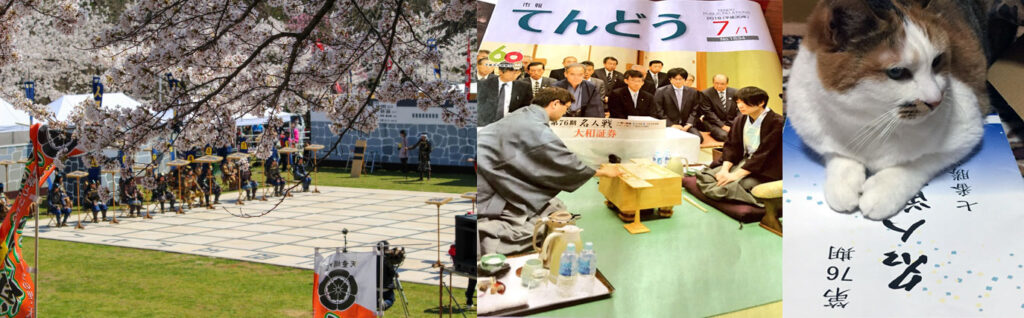
In spring, when the cherry blossoms on Mount Maizuru reach full bloom, the “Human Shogi” event is held at the summit. Warriors dressed in armor stand on the board, and the cheers of the spectators echo—it is a spring spectacle unique to Tendo.
In addition, student tournaments and professional title matches are held throughout the year, so events related to shogi take place year-round in Tendo City. The town also has workshops run by craftsmen and stores that demonstrate and sell shogi pieces, allowing visitors to actually observe the process of making shogi pieces.
Additionally, cultural facilities in the city offer hands-on events where you can learn the basics of shogi, allowing even beginners to experience how the pieces move and the enjoyment of playing a match. The reason this environment is well-established is that Tendo has spent many years as a “city that has lived with shogi.” For both tourists and locals, shogi thrives as a “culture embedded in everyday life.”
The Crafting of Shogi Pieces and the History of Tendo

The reason Tendo City is called the “City of Shogi Pieces” goes back to the policies of the Tendo Domain during the Edo period. At that time, to supplement financial difficulties, the domain encouraged its samurai to take up side jobs, one of which was making shogi pieces.
Samurai would put down their swords, carve wood, and pick up brushes. Over time, this craftsmanship spread throughout the region and eventually developed into a town-wide industry.
Taking this as a starting point, Tendo developed as a production center for shogi pieces, and eventually became known nationwide. After the Meiji period, a system of division of labor was established, and in addition to the “hand-carved pieces” made manually by craftsmen, the production of “Hori-ume pieces,” where the carving process was mechanized, also expanded.
In this way, Tendo grew into one of the leading mass production areas in the country. With its excellent technical skills and stable production volume, it is now known as Japan’s top production center for shogi pieces. While inheriting a history of over 100 years, the craft still thrives today as a traditional industry symbolic of Tendo City.
Even today, there are workshops in the city run by generations of skilled koma (Japanese chess piece) craftsmen, as well as new experiments by young artisans. Preserving tradition while evolving with the times—that is the charm of koma-making in Tendo, and it is the spirit of craftsmanship that flows throughout the entire town.
Strolling Around Tendo and Searching for Koma
As you walk through the town of Tendo, you will encounter designs inspired by shogi pieces everywhere. Bridge railings, streetlights, signboards, manhole covers—each one reflects the lively spirit of “Tendo, the Town of Shogi.”
It’s unique to Tendo that shogi motifs are not only present at tourist spots but also blended into everyday scenes. Every step feels like discovering a new shogi piece, allowing you to enjoy a stroll as if the entire town were a shogi board.
In front of JR Tendo Station
JR Tendo Station is a place befitting the gateway to “Shogi Town, Tendo.” As soon as you exit the station, you are greeted by large shogi piece monuments and decorations themed around shogi. The entire station plaza is adorned in a shogi motif.
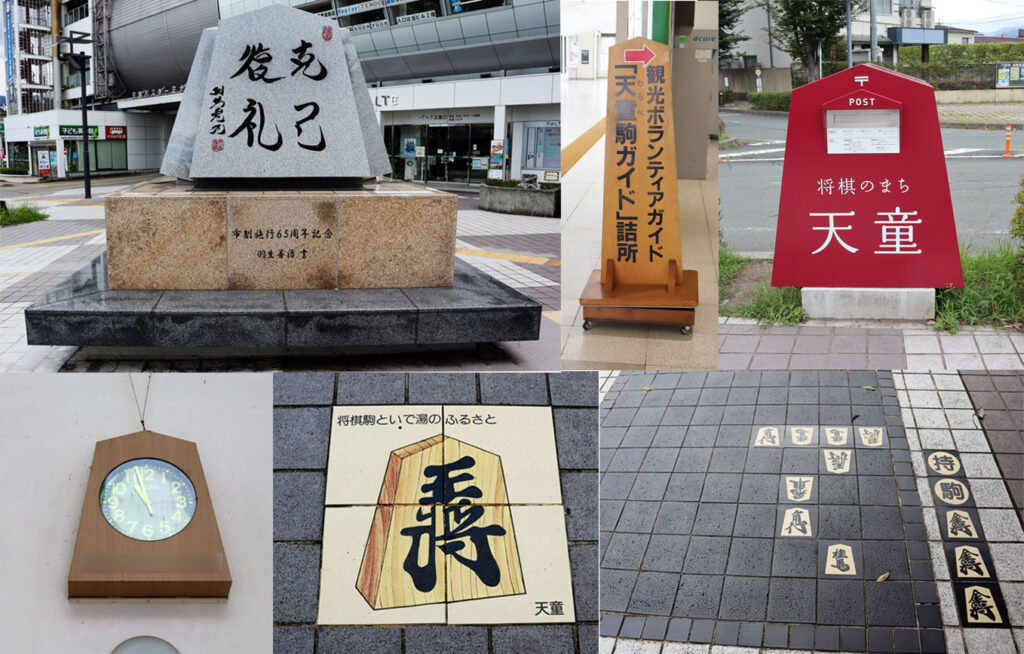
Inside the station building, there is the “Tendo Shogi Museum” and an community holl where you can experience playing shogi. The space allows you to feel shogi culture up close, with materials on professional matches and human shogi events.
Be sure to also check out the manholes on the ground. Some of them feature designs of shogi problem diagrams, giving you an experience as if you are “stepping into the world of shogi just by walking.” From the moment you arrive at the station, the shogi culture of Tendo welcomes you—this is that kind of place.
Mount Maizuru
Maizuru Mountain, a symbol of Tendo, is known as a famous spot where about 2,000 cherry trees bloom in spring. At the top of this mountain, the stage for the “Human Shogi” is set up every April, where warriors dressed as shogi pieces play matches on a giant board. The sound of the pieces and the beating of the drums, along with the cherry blossoms in full bloom, create a scene that truly represents “Tendo, the town of shogi.”
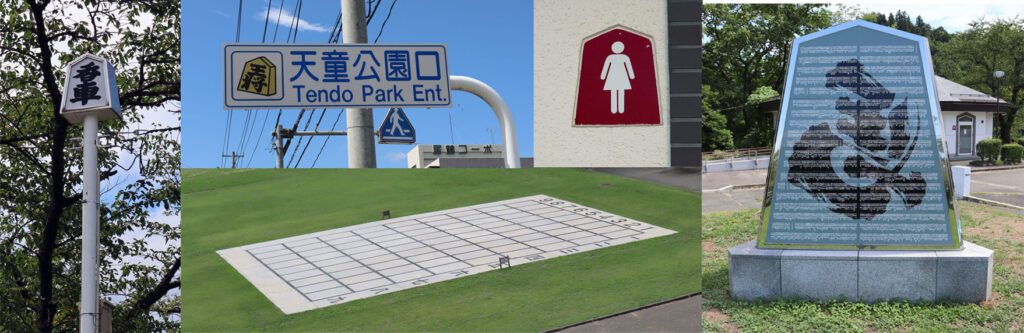
At the summit area, a giant shogi board has been installed, making it a popular spot where anyone can take commemorative photos. At night, streetlights shaped like shogi pieces softly illuminate the area, and together with the cherry blossoms, they create a magical atmosphere. The fact that it shows a completely different charm by day and by night is another unique appeal of Mount Maizuru.
Around Tendo City Hall
Walking around the area near Tendo City Hall, you can find shogi piece motifs in subtle places such as streetlights, signboards, and sidewalk tiles. It may not have the flashiness of a typical tourist spot, but it’s an area where you can feel that shogi has become a part of daily life.
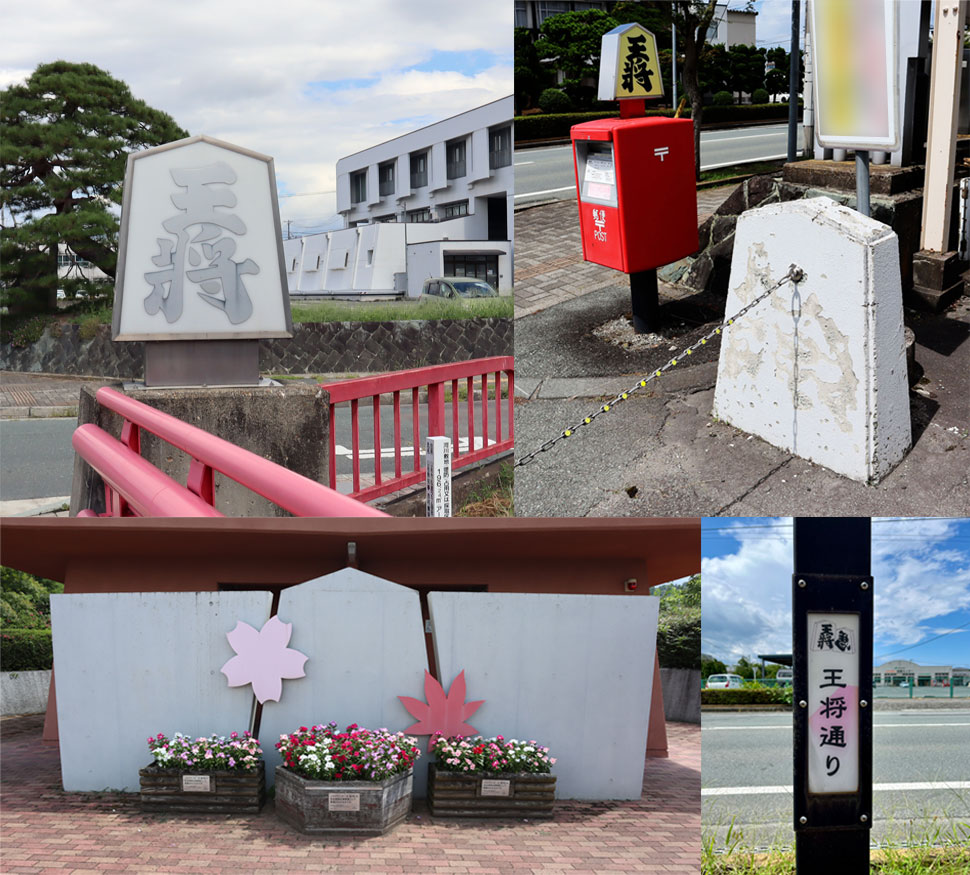
In addition to the traditional piece-shaped statues that have been around for a long time, new motifs with modern designs have also appeared in recent years. In this historic townscape, modern design blends harmoniously, allowing you to truly feel how shogi culture continues to thrive across the ages.
When you visit Tendo, be sure to take a leisurely walk around this area and look for the small shogi pieces hidden throughout the streets. You are sure to find unexpected discoveries along ordinary streets.
Hot Spring in Tendo City
When you walk around the Tendo Onsen area, you can find designs inspired by shogi pieces everywhere. From ryokan signs and streetlight decorations to information boards, the entire hot spring town is enveloped in an atmosphere that makes you feel like you are in a “shogi town.”

Tendo Onsen Town, a relaxing spot for local residents and also a popular destination for tourists, is filled with guideboards and signs shaped like horses. On the railings of the Kuratsu River bridge that continues near the city hall, there is also a “Ryu Oh” shogi pieace , offering visitors the enjoyment of rare discoveries. Additionally, you can have a unique experience by noticing a typo on the manhole cover for sewage on a road you pass by without much thought.
Huh, what’s this?? When I actually went looking, there were motifs of “と金” but none of “歩”?! Although the tourist map shows “歩,” when you visit the site, it only says “Ayumibashi = 歩橋.” That was a bit surprising.
Tendō’s symbol piece – infused with wishes as a lucky charm
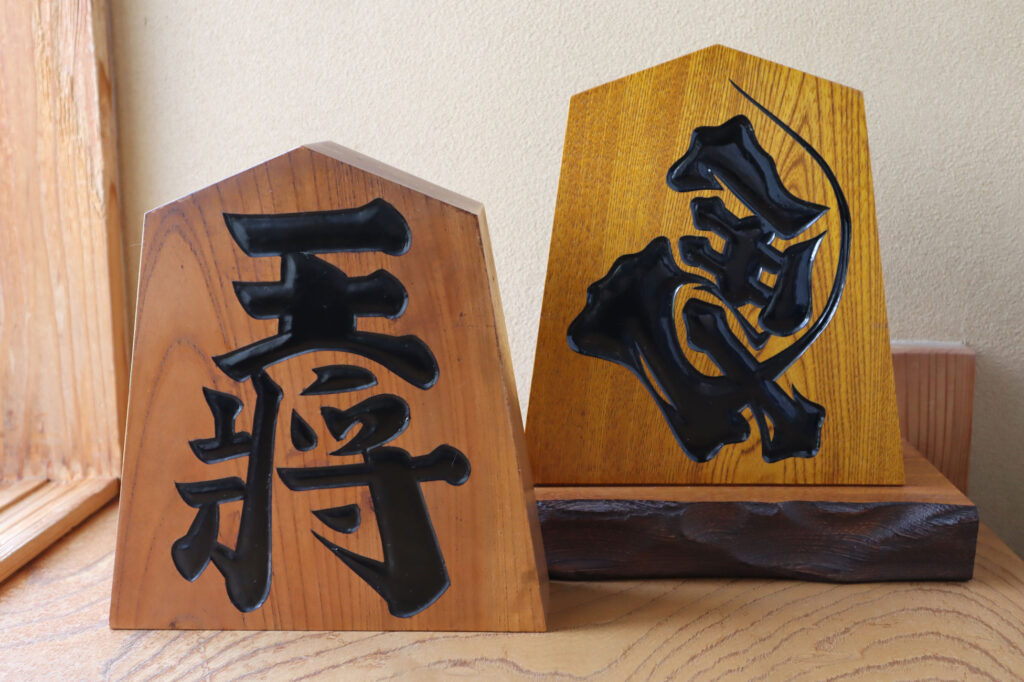
In Tendo, a town known for shogi, there has long been a custom of giving “decorative shogi pieces2 as gifts. These pieces are used to convey well-wishes for occasions such as housewarmings, business openings, and celebrating birthdays. Here, we will explain some of the popular pieces that are often given as gifts.
左馬”left horse”
The 左馬”left horse” is a unique lucky charm piece from Tendo, with the character for “horse” written in reverse. Traditionally, horses are mounted from the left side, and attempting to mount from the right may cause one to stumble and fall. Because of this, the 左馬”left horse” is believed to help people live a long life without stumbling. Additionally, since it is said that instead of people leading horses, horses come naturally to people, it carries the meaning of “many customers coming” and is considered an auspicious item that brings good fortune, serving as a charm for business prosperity.
Moreover, by wordplay, “u-ma” (horse) can be read as ‘ma-u’ (dance), symbolizing the invitation of good fortune. The shape of the Sama also resembles a tied pouch, further symbolizing wealth and serving as a charm for household safety. Even today, it remains a popular motif in Tendo, chosen for celebrations and as a souvenir by tourists.
王将”King”
This is a key piece in the game, and protecting it is essential to winning. If it is captured, you lose, making it a unique and irreplaceable piece in shogi. It is more important for this piece to “survive” than to attack. Because of this, in Tendo, it is chosen as a lucky piece for gifts, along with the 左馬”left horse,” carrying wishes for career advancement, success, and good fortune.
歩兵”Fuhyo”:Promotes to と金”Tokin”
A small and unassuming piece that can only move one square forward, but it can be a valuable asset throughout the game due to its sheer numbers. When promoted, it becomes a “Tokin,” gaining the movement abilities of a Gold General, making it a piece not to be underestimated. Recently, even in Tendo, the “Tokin” has come to be favored as a symbol of wealth and success, serving as a motif believed to bring good fortune.
The roles and personalities embedded in the pieces

Each of the other shogi pieces also has a role in the game. I’ve even heard stories of people always carrying these pieces as charms. In the town of Tendo, you can also find motifs of these pieces.
Rather than just looking at a piece and thinking, “It just looks like a piece,” wouldn’t it be more enjoyable to imagine, “What kind of meaning does this piece have?” while exploring? With that in mind, let’s introduce the characteristics and movements of some representative pieces.
飛車 “Hisha”: Promotes to “龍王 “Ryuo”
The strongest attacking piece that can move freely across the board vertically and horizontally, and it also serves to prevent enemy pieces from being dropped into your territory. Major piece (primary attacking piece). Can move any number of squares up, down, left, or right.
角行”Kakugyo”: Promotes to 龍馬”Ryuma”
The bishop, which can move greatly in diagonal directions, is the same type of major piece as the rook. It can move any number of squares diagonally, but is said to be weak in close combat.
金将”Kinsho”
It is the most reliable piece that protects the King and serves as a key to defense. While it is stronger in defense than in offense, it is a piece that excels in tight situations. It plays a role in maintaining the balance of formation and provides a sense of security.
銀将”Ginsho”: Promotes to 成銀”Narigin”
The Silver General, which can move forward as well as diagonally backward, is a piece that both defends and attacks alongside the Gold General. Compared to the Gold General, it is considered weaker in defense and is said to be more suited for offense.
桂馬”Keima”: Promotes to 成桂”Narikei”
In shogi, the only piece that can jump over other pieces is the Keima. It can only move forward, and once it reaches the edge of the board, it can no longer move, so it is said to be weak in defense. However, with its unique movement, it can be used for surprise attacks and plays a key role in penetrating deep into the opponent’s territory.
香車”Kyosha”: Promotes to 成香”Narukyo”
This piece, resembling a spear, moves only straight forward and is a linear attacking piece. It is indispensable for both defending and attacking the edges of the board, and in the endgame, it can also pose a threat to the opponent’s king.
Expanding Daydream Walks ― Imagining the Town of Shogi in Tendo and the Hometown of 8-dan Shogi Player Shimada in Manga “March comes in like a lion”

Tendo City is also known for its collaboration project with the manga “March Comes in Like a Lion.” In the story, the character Hachidan Shimada is from Tendo City, but his exact hometown is not revealed.
Shimada, who climbed mountains from a young age and worked incredibly hard to become a professional shogi player, evokes images of a boyhood spent in a quiet, snow-covered mountain village.
In reality, Tendo City also has quiet settlements scattered along the mountains to the east.
If you venture into areas such as Tamugino, Tsuyama, Kanazu, and Kanfu, where traditional houses and farmlands stretch out, it almost feels as if you have stepped right into the story.
In the work, Hachidan Shimada has a line: “It’s a place where everything is about to disappear. People, rice fields, schools, houses…” This also resonates with the current situation in Tendo City.
While new urban areas are expanding, there are also schools that have closed due to declining birthrates and villages with fewer residents.
Where Hachidan Shimada is originally from is left to the imagination, but one way to enjoy the setting of the work is to take a drive around these mountain-surrounded villages. (※Please be careful of wildlife.)
Summary
Walking around Tendo town, I found it quieter and more peaceful than I had imagined. The shogi piece motifs are subtle, yet they can be seen throughout the town—in monuments near the station, streetlights, manhole covers, and more.
This is not a form of “decoration for tourism,” but rather the everyday life of Tendo naturally blended with its long history and culture. You can truly feel that shogi continues to live on here as a part of the town’s culture and as a source of pride for its people.
The chess pieces at your feet, the decorations on the bridge railings, and the wishes imbued in the ornamental pieces.
Each of them speaks to you like a small message, telling the story of “time in this town.” If you have the chance to visit Tendo, don’t just go sightseeing—take a leisurely walk through the town and enjoy “searching for pieces.”
Surely, you too will be able to see the “story of shogi” that this town has treasured for so long.
![[Yamagata, Tendo City] Tendo Park & Mt. Maizuru: Leisure Walk in Tendo’s Nature デスクトップ向け](https://bongheiberg.yamagata.jp/wp-content/uploads/2025/09/20250912-1024x768.png)
![[Yamagata, Tendo City] Takeisao Shrine, dedicated to Oda Nobunaga | Goshuin and Konpeito Worship Report デスクトップ向け](https://bongheiberg.yamagata.jp/wp-content/uploads/2025/07/image6.jpg)
- #Craft
- #craft workshop
- #Day trip hot spring
- #gift
- #gift2
- #history
- #hot spring
- #Lucky Charm Shogi Piece
- #manhole
- #March Comes in Like a Lion
- #professional shogi player
- #Shogi
- #Shogi Knight
- #shogi pieces
- #Shogi Town
- #Shogi Town1
- #Surrounding sightseeing
- #Tendo Shogi Museum
- #walking
- #walking1
- #walking2
![[Yamagata, Yamagata City] Summer trip|Relaxing and Enjoying the nostalgic atmosphere of Gotenzeki アイキャッチ](https://bongheiberg.yamagata.jp/wp-content/uploads/2025/08/gotenzeki_shop.png)

![[Yamagata, Tendo] Enjoy authentic gelato at the sports park! Made by Italian-trained artisans at “COZAB GELATO” アイキャッチ](https://bongheiberg.yamagata.jp/wp-content/uploads/2025/09/top-scaled.jpg)
![[Yamagata, Shonai] Kumagaya Shrine, the birthplace of Kamenoo | Learn about the life of Kumagai Saburobei, the god アイキャッチ](https://bongheiberg.yamagata.jp/wp-content/uploads/2025/09/20260223160400_74.jpg)
![[Yamagata, Murayama] Link MURAYAMA’s pizza shop “pizza nu-ma” | Delicious pizza tasting report アイキャッチ](https://bongheiberg.yamagata.jp/wp-content/uploads/2025/09/pizza-nu-ma7.png)
![[Yamagata・Shonai Town] A blissful moment in the stylish space of the town bath | Shonai Town Gallery Onsen アイキャッチ](https://bongheiberg.yamagata.jp/wp-content/uploads/2025/09/machiyu_top-3.jpg)