

[Yamagata, Murayama] Higashizawa Rose Park | Vibrant Roses and the Little-Known History of “Sturgeon breeding”
2025/02/27 This site contains advertisements. Category: park
![[Yamagata, Murayama] Higashizawa Rose Park | Vibrant Roses and the Little-Known History of “Sturgeon breeding” アイキャッチ](https://bongheiberg.yamagata.jp/wp-content/uploads/2025/03/a11b4bb3ba448d1fa402ac3dc62cc91f-2-640x414-1.jpg)
Higashizawa Rose Park, spread out in the mountains of Murayama City, Yamagata Prefecture, is one of Japan’s leading rose gardens, boasting 20,000 rose bushes across approximately 7 hectares. It has also been selected as one of the “100 Fragrant Landscapes” by the Ministry of the Environment, and every June and September, a Rose Festival is held, attracting many visitors from both Japan and abroad.
Although it is a splendid rose garden, did you know that about 30 years ago, sturgeon were being experimentally raised within the park? While there are no traces of this today, knowing about it can make a walk through Higashizawa Rose Park even more enjoyable.
This time, we will introduce the highlights of Higashizawa Rose Park as well as the little-known history of sturgeon.
What is Higashizawa Rose Park?
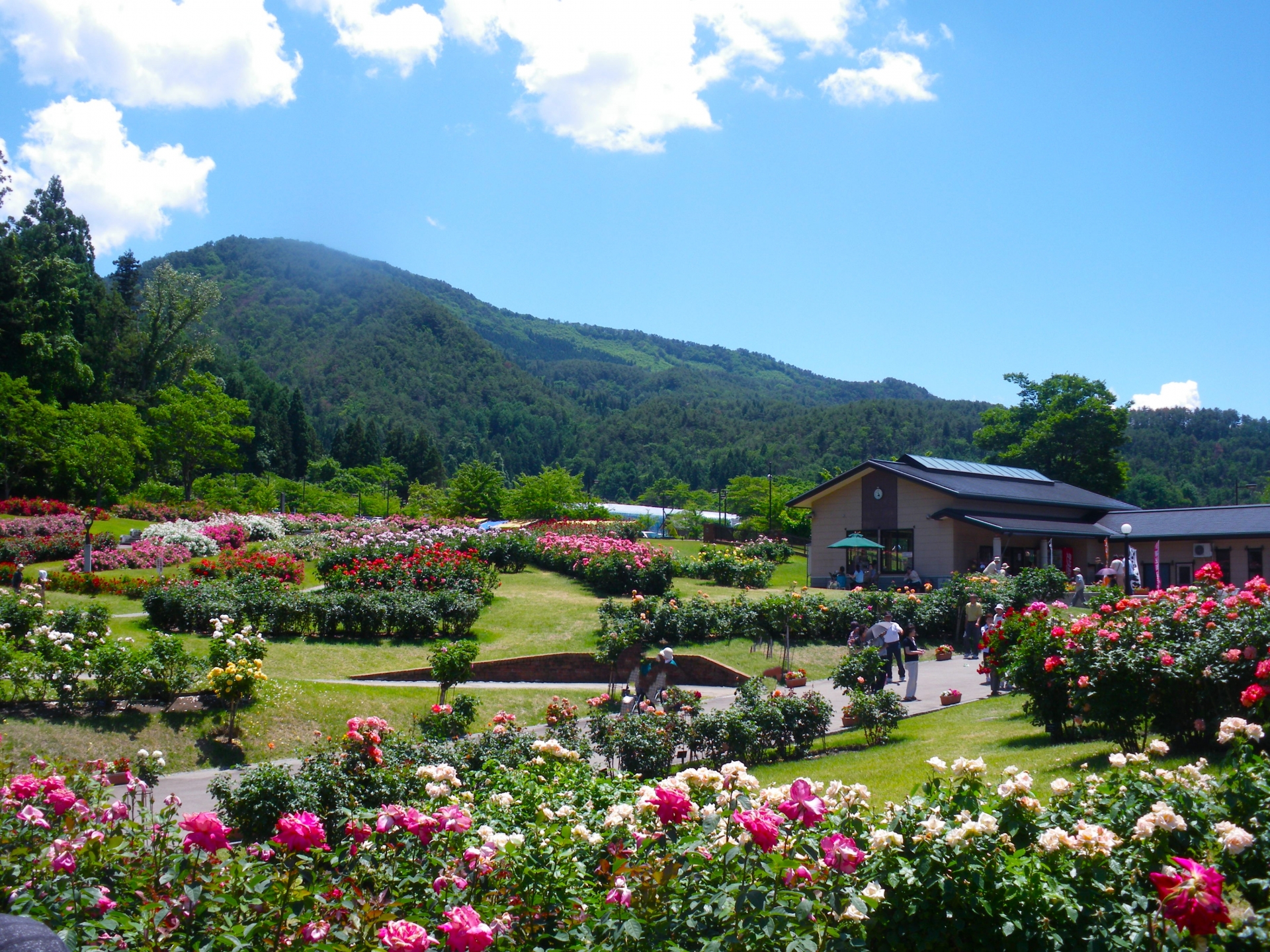
Higashizawa Rose Park is a municipal park located in the Higashizawa area of Murayama City, Yamagata Prefecture. It covers approximately 7 hectares (about 1.5 times the size of Tokyo Dome) and is home to 750 varieties and 20,000 rose plants. Walking through the park, visitors are surrounded by vibrant flowers and a rich fragrance, offering an enjoyable experience.
Among the many rose gardens across Japan, Higashizawa Rose Park holds a special place. It is the only rose garden recognized in the “Top 100 Fragrant Landscapes” selected by the Ministry of the Environment and is highly praised as a park where visitors can fully enjoy the scent of roses with all their senses.
Every year in June and September, the “Rose Festival” is held, where visitors can enjoy fully bloomed roses that vividly color the garden, along with concerts, events, and local gourmet food stalls, attracting many tourists. From spring to autumn, in addition to roses, visitors can enjoy swan boats on the Tameike Pond, the spacious lawn area, and children’s playground equipment, making it a popular spot for families and couples as well.
In winter, the park is covered in snow, making it impossible to stroll around, but the view of the rose garden sleeping under the snow is also charming. It is one of the attractions that shows a different face through the four seasons.
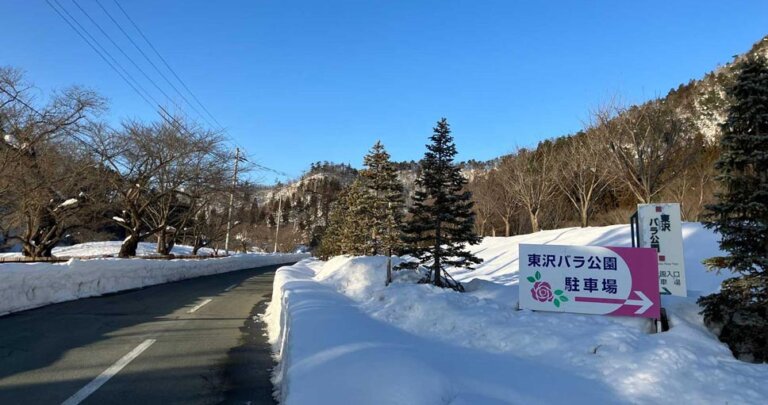
The roadway is barely plowed, so you can proceed (up to just before Higashizawa Reservoir), but you cannot set foot inside the rose garden.
How to Get to Higashizawa Rose Park
Higashizawa Rose Park can be reached by exiting the east exit of JR Murayama Station and heading straight toward the mountain in front. It is possible to walk from the station, but since there is an uphill slope, using a rental bicycle (closed in winter) or a one-coin taxi (500 yen) is more convenient.
If you are visiting by car, there is a free parking lot on the premises, so you can rest assured.
It is conveniently located for stopping by during sightseeing or outings, and is recommended not only during the rose season but also for walks or breaks. Please note that business hours may change during events. When going out, be sure to check the latest information on the official website in advance.
| Spot Name | Higashizawa Rose Park |
|---|---|
| Phone Number | Murayama City Commerce and Tourism Division: 0237-55-2111 Murayama City Tourism and Local Products Association: 0237-53-1351 |
| Business Hours | Rose Exchange Hall: Weekdays 10:00 AM – 3:00 PM / Weekends and Holidays: 10:00 AM – 4:00 PM *The park can be entered after 4:00 PM |
| Regular Holidays | Rose Exchange Hall / Shop: Wednesdays (Open daily during the Rose Festival) *Closed for winter from November to March |
| Address | 1-25 Tateoka Higashizawa, Murayama City, Yamagata 995-0023, Japan |
| Access | 5 minutes by car, 32 minutes on foot from JR Murayama Station About 10 minutes by car from Murayama IC on the Tohoku-Chuo Expressway |
| Parking | Available (free) |
| Fees | Free except during the Rose Festival Rose Festival: Adults 600 yen / Elementary and middle school students 300 yen |
| Official HP・SNS | Higashizawa Rose Park Official Website |
It Actually Has a Unique History
Today, Higashizawa Rose Park is known as one of the country’s top rose destinations, but in the past, an unexpected initiative took place here. That was ‘sturgeon breeding’.
About 30 years ago, with the aim of creating specialty products for Murayama City, trial breeding of sturgeon began in the park’s ponds and other water bodies. Although you can no longer see them today, that challenge remains in the memories of the local people and has become a part of the park’s history.
What is a sturgeon?
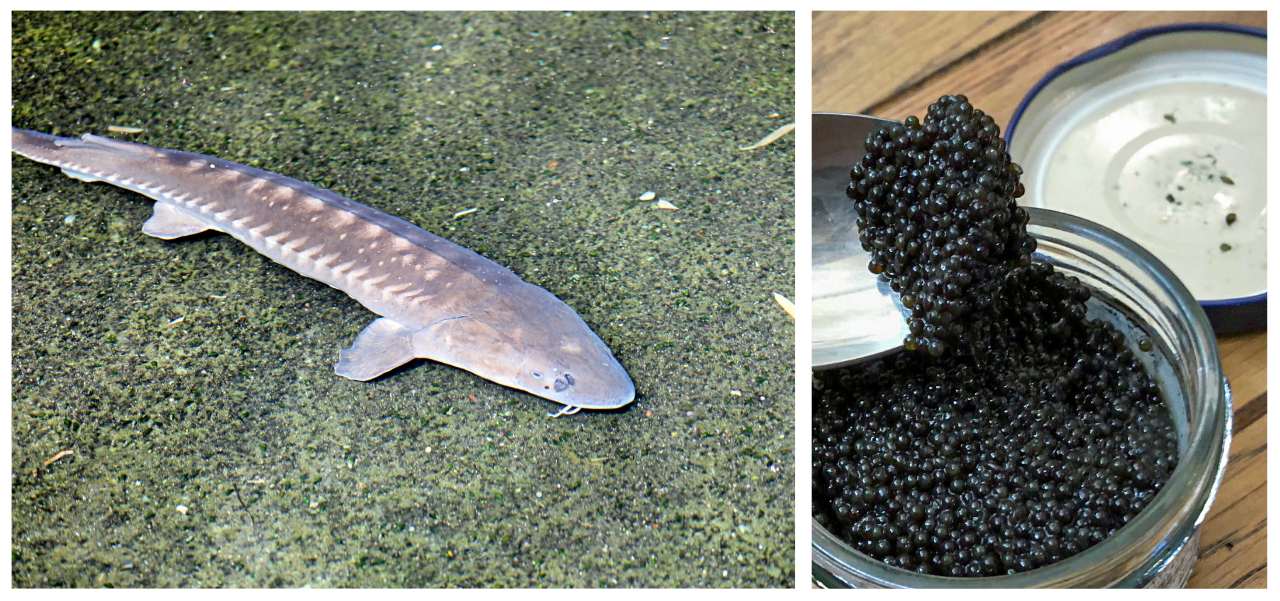
Have you ever actually seen a sturgeon?
Sturgeons are large freshwater fish that inhabit areas ranging from freshwater to brackish water. They are named ‘shark’ because they resemble a shark in appearance, but they actually belong to the bony fish category and are completely different from sharks (cartilaginous fish).
Due to their appearance, they are said to have come to be called ‘sturgeon,’ meaning ‘shark with scales like a butterfly.’ They have a gentle temperament, no teeth, and do not attack humans.
Their appearance has hardly changed for over 300 million years, earning them the nickname ‘living fossils.’ The average body length is 1 to 3.5 meters, with a lifespan of around 50 to 60 years. Some individuals are said to live up to 150 years and exceed 5 meters in length.
Furthermore, sturgeon eggs are known as the luxury food ‘caviar’ and are counted among the world’s three major delicacies. The sturgeon raised at Higashizawa Rose Park was a variety called ‘Bester.’
Where in Higashizawa Rose Park were the sturgeon?
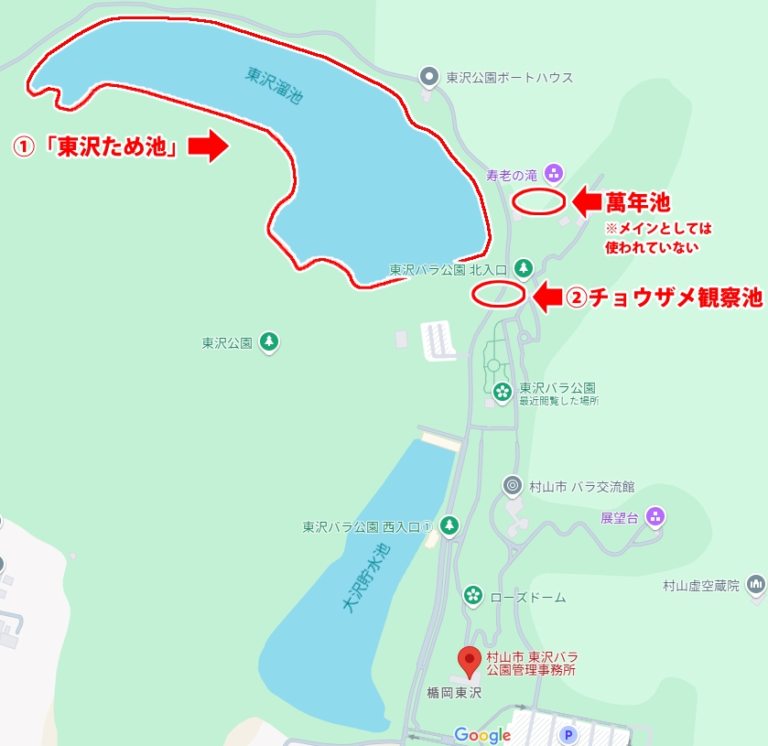
Higashizawa Rose Park is located slightly uphill from the center of Murayama City. At the heart of the park is the vast “Higashizawa Reservoir,” surrounded by rose gardens and walking paths. In this corner of rich natural space, experimental sturgeon breeding was conducted about 30 years ago.
The main places where they were bred are the following three locations:
Higashizawa Reservoir
It is a large irrigation pond in the park, covering 6.5 hectares with a depth of about 10 meters. The water temperature at the bottom is around 16 degrees, considered suitable for sturgeon.
At its peak, more than 200 sturgeons were released, making it the center of sturgeon cultivation. Fishing was prohibited, and it apparently attracted significant interest from outsiders as well.
Sturgeon Observation Pond
It was a small pond located near the North Entrance Gate, measuring 4m by 9m with a depth of about 90cm. Around 50 fish were kept here, and it was popular as a place where visitors could observe sturgeons up close. Currently, there is no trace of it left.
Mannen Pond
A small pond located further north of the “Observation Pond.” Although it was not the main habitat, it is said that a few sturgeons were released there as a backup. At the time, many visitors to the park probably never imagined that sturgeons were swimming right next to the rose garden.
The Beginning and End of Sturgeon Breeding
The breeding of sturgeon in Murayama City began in 1990 (Heisei 2). The opportunity arose when a local resident was raising sturgeon in a pond at their home. With the idea that ‘perhaps it’s not too difficult to raise them,’ a full-scale trial breeding program was started at Higashizawa Rose Park.
| October 1990 | Released 50 fish into Higashizawa Reservoir |
|---|---|
| May 1991 | The sturgeon observation pond was completed, and a few fish were also released into Mannen Pond |
| May 1992 | Added 50 more fish each to Higashizawa Reservoir and the observation pond |
| June 1994 | Released 250 fish into the reservoir |
Releasing continued afterwards, and by around 1998, a total of about 800 sturgeons had been raised.
However, raising them in a natural environment was not easy. The reservoirs suffered from water shortages in the summer, and drastic changes in water temperature created harsh conditions for the sturgeon. Gradually, their numbers decreased, and when renovation work for the Higashizawa Rose Park was planned in 2001, the ‘observation pond’ disappeared from the map.
Then, with the park’s reopening in 2002, the sturgeon completely vanished from the park.
Why the Sturgeon Disappeared
Raising sturgeon at Higashizawa Rose Park was a dreamlike challenge, but the environment of a natural pond was far from ideal.
Sturgeon naturally prefer clean, flowing freshwater. However, ponds have poor water circulation and are prone to water shortages and deterioration of water quality in the summer. In addition, the climate of the Murayama Basin, with its large temperature fluctuations, posed a significant burden to sturgeon, which require stable water temperatures.
These conditions combined, and the hundreds of sturgeon that had been released gradually disappeared. Although the city initially considered caviar production, it never came to fruition, and before long, it became known as a “phantom project.”
“Lake Town Higashizawa,” Where You Could Taste Sturgeon
Right next to Higashizawa Rose Park was once the hot spring facility “Lake Town Higashizawa.” Starting in 1995, this place actually served sturgeon dishes.
The menu was not limited to caviar; it also included a wide variety of dishes such as shabu-shabu, karaage, and hot pot. Full-course meals priced up to 10,000 yen were available, allowing guests to enjoy various cooking styles from Japanese, Western, and Chinese cuisine. Those who actually tasted the food remarked, “The sturgeon karaage was very delicious.”
However, the dishes used farmed sturgeon sourced from Iwate Prefecture. The plan to use sturgeon raised in Higashisawa Rose Park as ingredients never came to fruition.
Afterwards, the facility was closed, and currently, a nursing home has been built on the site.
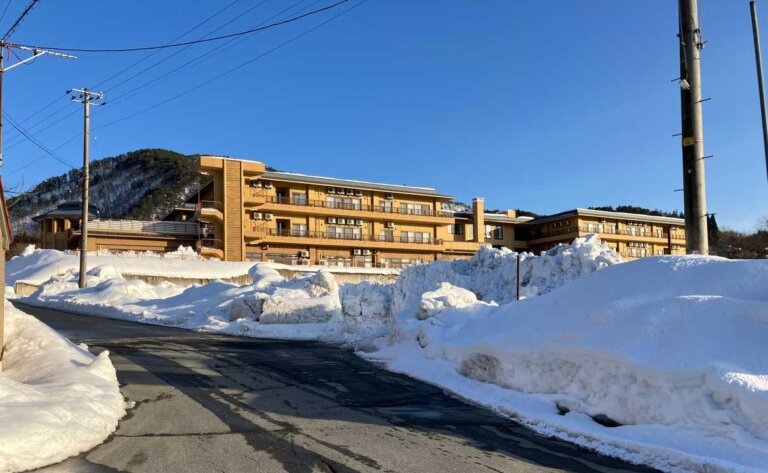
The hot springs and sturgeon dishes have disappeared, but locally it is still remembered as ‘a rare facility where sturgeon could be eaten.’
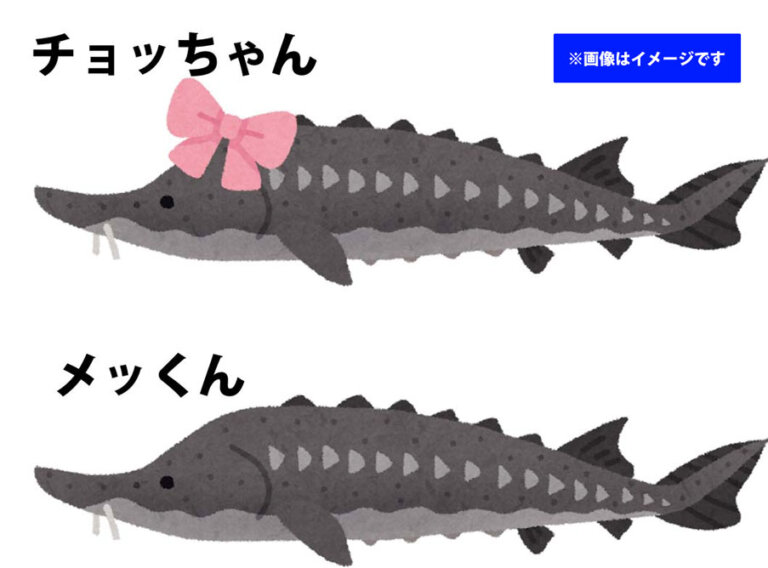
As an aside, at that time, there were also sturgeon mascot characters: a girl named “Chocchan” and a boy named “Mekkun.” Their names were chosen through a public contest, and they were popular at events and in pamphlets.
Also Appeared in the Manga ‘Tsurikichi Sanpei’

The sturgeon breeding at Higashizawa Reservoir has not only been known locally but also became the subject of a manga. Takao Yaguchi’s masterpiece, ‘Fishing Fool Sanpei Heisei Edition (4) The Master of Akazawa Dam’ (Kodansha), includes a story modeled on this Higashizawa Reservoir and the sturgeon.
In the story, the protagonist, Sanpei, attempts to catch a giant sturgeon that has settled in the reservoir. Since it is based on the actual ‘sturgeon breeding at Higashizawa Reservoir,’ the story feels oddly realistic despite being fictional.
It’s a book that sparks the romantic idea of “Could they still be surviving somewhere?” and it became a topic of conversation even in the local area. If you’re interested, please give it a read.
How to Enjoy Higashisawa Rose Park
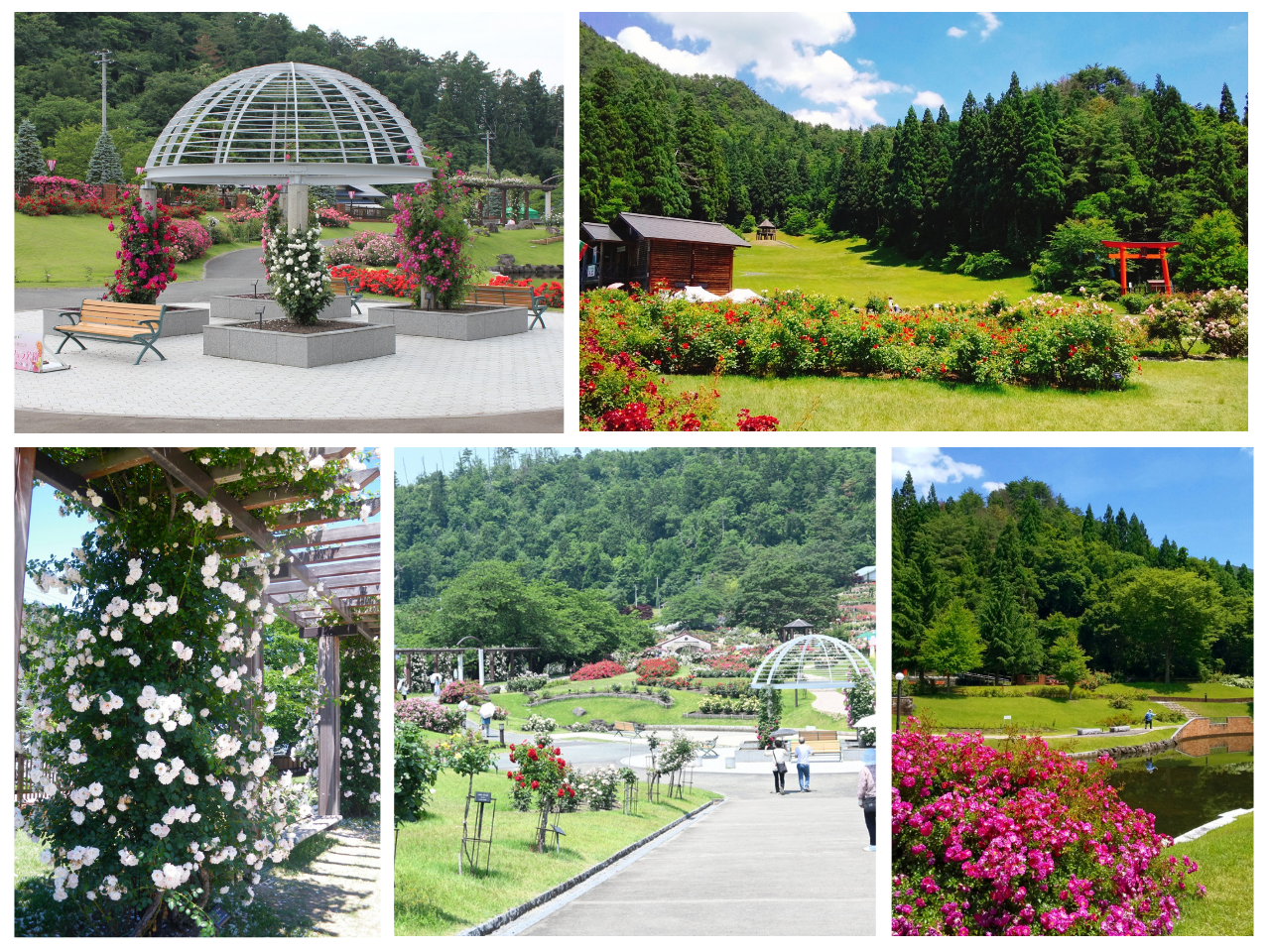
Speaking of Higashizawa Rose Park, it is now known as one of the leading rose gardens in the country. About 7 hectares of land are home to 750 varieties and 20,000 rose bushes, and the “Rose Festival” is held every June and September. The park is filled with a sweet fragrance, and stage events and markets take place, attracting many tourists.
At the Higashizawa Reservoir, swan boats operate from spring through summer. The view of the rose garden and surrounding nature from the pond is truly exceptional.
Within the park, there is also the “Rose Exchange Hall,” where you can enjoy sweets made from roses. Menus like rose ice cream and rose parfaits, which can only be eaten here, are very popular. Additionally, there is a large lawn, playground equipment, and a waterfall, making it a spot that can be enjoyed by both adults and children.
With rest areas, benches, toilets, and vending machines available, you can spend a leisurely day here with a picnic-like feeling.
Summary
Higashizawa Rose Park has a unique history, having once raised sturgeon in an attempt to make them a local specialty. Today, it is loved by many as one of the country’s leading rose gardens.
You can enjoy the changing seasons, and during the “Rose Festival” in June and September, the garden is beautifully decorated, with rose-themed sweets and gourmet treats available. There are also swan boats on the pond, a large lawn area, and playground equipment for children, making it a great spot for families.
While reflecting on the memories of past sturgeon cultivation, taking a walk through the current beautiful rose garden allows you to feel the deep history unique to this place.
![[Yamagata, Tendo City] Tendo Park & Mt. Maizuru: Leisure Walk in Tendo’s Nature アイキャッチ](https://bongheiberg.yamagata.jp/wp-content/uploads/2025/09/20250912.png)
![[Takahata, Yamagata] Experience Uriwari Rock Garden Park アイキャッチ](https://bongheiberg.yamagata.jp/wp-content/uploads/2025/07/IMG_3542-scaled.jpg)

![[Yamagata, Obanazawa City] Torimotsu Chuka Soba Yamahachi Kinsuke|Why Even Non-Ramen Lovers Visit アイキャッチ](https://bongheiberg.yamagata.jp/wp-content/uploads/2026/01/202602231539071-1.jpg)
![[Yamagata, Sagae City] Popular souvenir “Yamitsuki Shimikarisen” really impossible to buy? アイキャッチ](https://bongheiberg.yamagata.jp/wp-content/uploads/2026/01/20260223153907_40.jpg)
![[Tendo City, Yamagata] Menya Imajin Leap|A Popular Ramen Shop! Fish-based miso Broth アイキャッチ](https://bongheiberg.yamagata.jp/wp-content/uploads/2025/09/20260223155236-20260223155236leap1.png)
![[Yamagata, Kaminoyama] HATAKE STYLE Kaminoyama Store | Parfait Made with Seasonal Fruits アイキャッチ](https://bongheiberg.yamagata.jp/wp-content/uploads/2026/01/hatake-style202602231552361.jpg)