[Yamagata, Yonezawa City] 3 Popular Pilgrimage Spots for the Movie ‘Suki demo Kirai na Amanojaku’|A Location Guide for Touring in Winter
2026/02/17 This site contains advertisements. Category: Going out
![[Yamagata, Yonezawa City] 3 Popular Pilgrimage Spots for the Movie ‘Suki demo Kirai na Amanojaku’|A Location Guide for Touring in Winter アイキャッチ](https://bongheiberg.yamagata.jp/wp-content/uploads/2026/02/sukiama-eyecatch.jpg)
The film Movie ‘Suki demo Kirai na Amanojaku’, set mainly in Yonezawa City, Yamagata Prefecture. Although the story takes place in summer, it depicts a striking scene of “snow falling in summer.”
This time, I deliberately visited Yonezawa in winter and went to three locations that appear in the film. Walking through the actual snowy scenery made me truly feel the presence of snow rooted in this area, making the setting of the story feel more tangible.
All of these locations are easily accessible from the city, making them perfect spots to visit during a sightseeing trip. In this article, I will introduce them as a pilgrimage route that can be enjoyed along with a winter walk around the town.
What is Movie ‘Suki demo Kirai na Amanojaku’? (Spoiler-free explanation)

The film ‘Suki demo Kirai na Amanojaku’ is a Japanese animated work set to be released in 2024. It is a coming-of-age fantasy set primarily in Yonezawa City, Yamagata Prefecture, and other locations within Yamagata Prefecture.
The story begins when a high school student, who is struggling with how to relate to others, meets a girl who is a demon, setting the plot in motion. Snow falling on a summer town, the serene landscapes of a regional city, and the appearance of an unfamiliar being all overlap, creating a fantastical world unique to this work.
It is said that the story was inspired by the striking scene of “snow falling in summer,” and the motif of snow quietly and symbolically colors the overall atmosphere of the story.
The film is produced by Studio Colorido and directed by Tomotaka Shibayama.
Studio Colorido has worked on films such as ‘Penguin Highway’ and ‘A Whisker Away,’ and is well known for its depiction of subtly extraordinary elements woven into realistic scenery. In this work as well, the streets and snowy landscapes of Yamagata are portrayed in close connection with the emotions of the story.
Tomotaka Shibayama is an animator who came from Studio Ghibli and has participated in films such as ‘Spirited Away’ and ‘Howl’s Moving Castle.’ His direction, which carefully depicts everyday gestures and the atmosphere between characters, is strongly reflected in this work as well.
The entire city of Yonezawa serves as a pilgrimage site supporting the story
The setting of ‘Suki demo Kirai na Amanojaku’ is not limited to so-called tourist spots. It is depicted in a way that naturally blends into the everyday scenery of Yonezawa, including the street in front of the station, temples and shrines, and long-established confectionery shops.
Rather than prominently featuring a special ‘sacred site’ atmosphere, it gives the impression that the regular streets and scenery of the city serve as the background for the work.
In the work, the extraordinary setting of ‘snow falling in summer’ is symbolically depicted, but in reality, Yonezawa is a regional city where people come and go, especially around the station, and you can feel the sounds of daily life and human activity.
Even so, if you walk along back streets, temple grounds, or streets close to residential areas, there are moments when the flow of time suddenly feels slow. In such scenes, it sometimes seems to overlap with the atmosphere depicted in the work.
Rather than walking to find specific scenes, there’s a sense of realization afterward that ‘this place might also exist on the continuation of the story.’ When you revisit the work after a pilgrimage, the breadth of the station square and the distances along the streets become a little more concrete.
The work and the real city do not perfectly overlap, but their outlines become slightly clearer.
That was the honest feeling of pilgrimage I actually experienced while walking around Yonezawa.
As a stage where such an atmosphere is depicted, we will introduce spots in the Okitama and Murayama areas listed on the location pilgrimage map.
Main Pilgrimage Sites in the Okitama Area
The Okitama area, which includes Yonezawa City at the center of the story, has various pilgrimage sites scattered from the city area around the station to the suburban hot spring resorts. Many spots naturally blend into the everyday townscape, making it an area where you can enjoy overlaying the scenery of the work while exploring on foot or by car.
The main pilgrimage sites are as follows:
- Yonezawa Station
- Sashiizumi Benzaiten
- Suminoe Bridge
- Yonezawa Municipal First Junior High School
- Yamagata Prefectural Yonezawa Commercial High School
- Sasano Kannon
- Saijo Tenma Park
- NCV Yonezawa Center
- Onogawa Onsen Houju no Yu
- Uriwari Stone Garden Park
- Tenoko Station
Main Pilgrimage Sites in the Murayama Area
The Murayama area also features impressive locations seen in the work, such as Kaminoyama, Yamadera, and around Zao. There are many natural landscapes and scenic viewpoints, and by visiting them along with the Okitama area, you can more fully experience the extent of Yamagata that served as the setting of the story.
The main pilgrimage sites are as follows:
- Kaminoyama Civic Park
- Hanasakiyama Observatory
- Shiroyama Children’s Park
- Yamadera Hie Shrine
- Zao Miharashi Hill
- Yamadera Hōju Bridge
- Zao’s Okama Crater
You can download the location pilgrimage map from here .
*Please check the official website for the latest information.
A Pilgrimage in Yonezawa to Enjoy Especially in Winter
Among the pilgrimage sites of “Suki demo Kirai na Amanojaku,” this time we focused on Yonezawa City, which is mainly depicted as the setting of the story, and actually visited the locations.
The story begins with the striking scene of “snow falling in summer.” Because of this, some people might imagine summer when thinking about the pilgrimage.
However, this time we deliberately visited Yonezawa in winter. Walking through the actual snowy landscape makes you realize that the snow, symbolically depicted in the work, is part of the everyday scenery rooted in this land.
Yonezawa Station (JR)|The Place Where the Story Begins
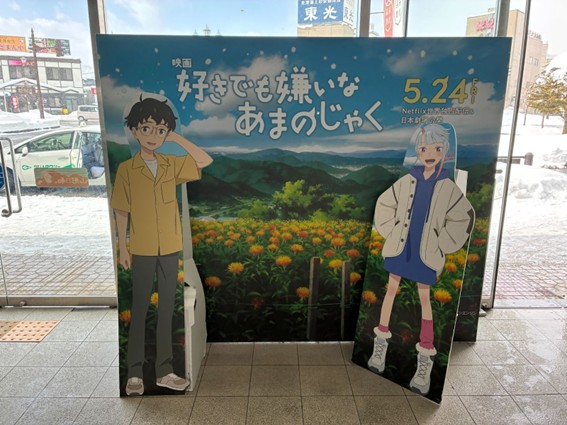
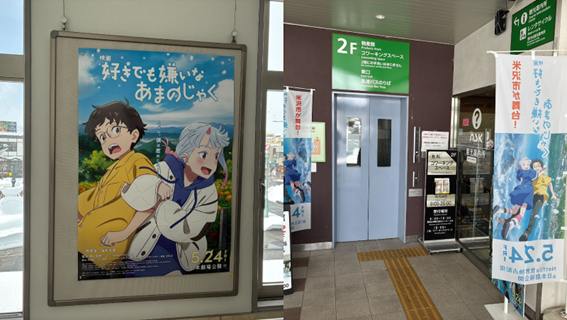
In front of Yonezawa Station in winter, there is a quietness that is somewhat different from urban stations. Since Yamagata is a region where people mainly travel by car, there are not that many people walking around even near the station. In particular, in winter, the presence of people feels a bit sparse.
That said, it is not completely quiet. Cars and taxis picking up Shinkansen passengers, buses coming and going, and students commuting at certain times can be seen, creating a station square scene typical of a regional city where tourists and local life intersect. Inside the station, souvenir shops, standing soba restaurants, and convenience stores are lined up, giving a sense of calm as a gateway to a castle town rather than being a glamorous tourist station. It is a place where travel and everyday life naturally overlap.
In the movie ‘Suki demo Kirai na Amanojaku,’ Yonezawa Station is depicted as an important place that evokes the beginning of the story. When standing in front of the station in reality, there was an atmosphere that made you want to overlay the feeling of ‘this is where the story began to move.’
Even now, decorations that evoke the film remain in and around the station, allowing you to experience the lingering impression of the movie.
For a pilgrimage, Yonezawa Station is the starting point where both the story and city walk begin. From here, as you head to various locations around the city, the landscapes of the work and reality gradually start to overlap.
A quick warm-up gourmet stop at Yonezawa Station|Tachisoba-dokoro Taka
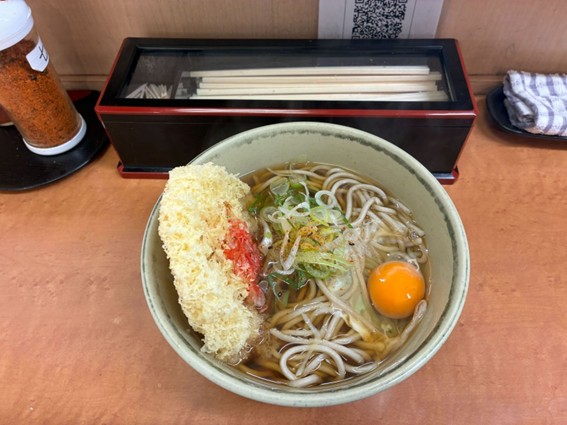
If you start your pilgrimage from Yonezawa Station, while it is not directly related to the work, the first place you might want to stop by is ‘Tachisoba-dokoro Taka’ located inside the station building. The soba served in a standing-eating style is perfect for a meal while waiting for a train or before traveling. Before heading on the pilgrimage, I decided to have a quick bite and had the tentama soba this time. The standing soba shop inside the station is convenient as a place to have a warm meal immediately after arriving. The service is also quick, and during the cold season, it warms your body. Rather than being a special local dish, it is a meal unique to stations where you can eat quickly during travel. Seeing locals and tourists slurping soba in the same space gives a sense of the everyday atmosphere at Yonezawa Station.
| Spot Name | Tachisoba-dokoro Taka |
|---|---|
| Phone Number | 0238-22-1311 |
| Business Hours | 7:00 AM – 6:45 PM |
| Closed | Open every day |
| Address | 3-1-1 Higashi, Yonezawa City, Yamagata 992-0027, Inside the west exit station building, outside the JR Yonezawa Station ticket gates |
Sasano Kannon (Sasano Kanzeon)|A Pilgrimage Spot Where Time Flows Slowly
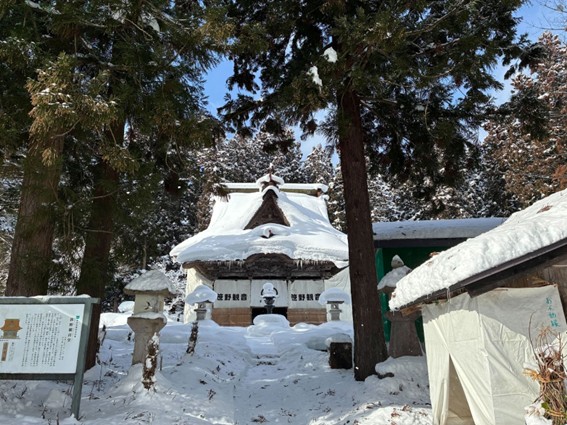
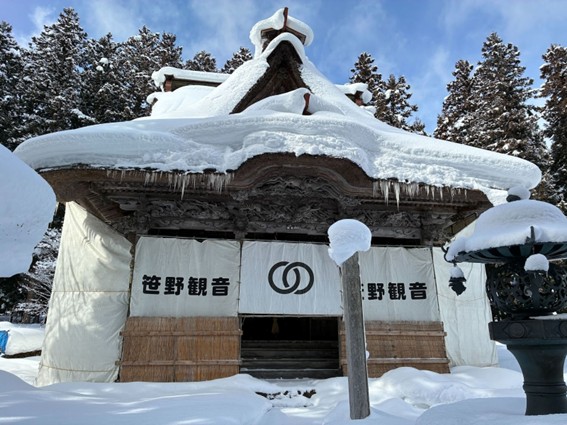
The Sasano Kannon (Sasano Kanzeon), impressively depicted in the movie ‘Suki demo Kirai na Amanojaku’, is a historic temple said to have been founded during the Heian period, with an Eleven-Faced Kannon as its principal image. In the story, the calm and serene atmosphere seems to resonate with the emotions of the characters.
In the work, scenes evoke the feeling of summer, but actually visiting in winter revealed a different side of the temple.
At the time of the visit, the area around the main hall was covered in a blanket of snow, but the approach and the front of the main hall had been cleared, allowing visitors to worship while carefully watching their step. Although the front gate was closed, following the signs led us to the temple grounds via a side path. The snow-covered grounds at times had few visitors, enveloped in a quietness that made the passage of time feel slow and gentle.
It takes about 15 minutes by car to reach Sasano Kannon from Yonezawa Station. It is located in a place surrounded by nature, a little away from the city center. During winter, the way to access the temple grounds may change depending on the snow conditions, so it is safe to follow the local guide signs when heading to the temple.
| Spot Name | Kōtokuin Sasano-dera (Sasano Kannon) |
|---|---|
| Phone Number | 0238-38-5517 |
| Business Hours | 9:00 AM – 4:00 PM |
| Closed | No holidays |
| Address | 5686-5 Sasano Honmachi, Yonezawa City, Yamagata Prefecture 992-1445 |
| Parking | Available |
Baikado | A long-established confectionery shop you want to stop by during your pilgrimage
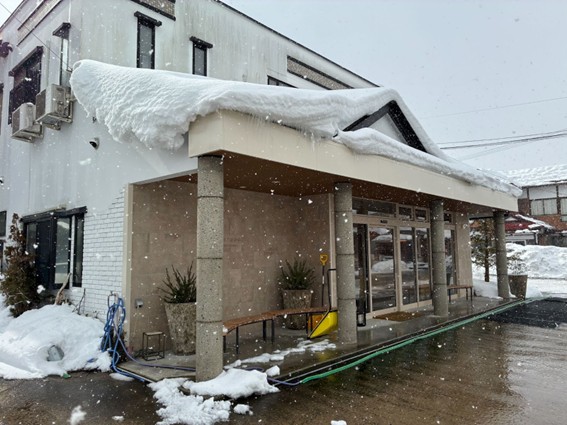
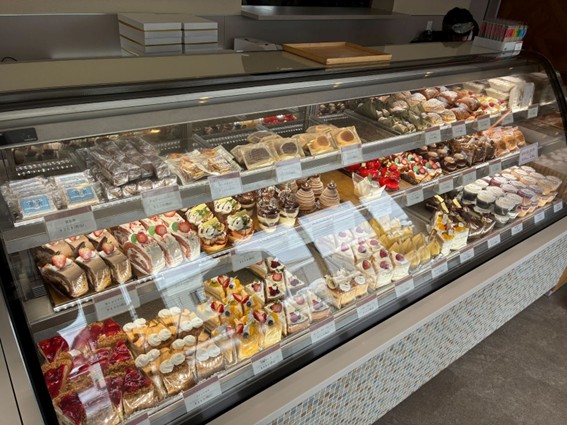
Baikado is a local Western-style confectionery shop that has been beloved by the community for a long time. Inside the shop, in addition to cakes and baked sweets, there are also bread products, offering a selection typical of a confectionery that locals use in their daily lives.
In the movie ‘Suki demo Kirai na Amanojaku,’ it appears not as the stage for any special events, but as part of the everyday scenery that shapes the background of the story. After the release of the film, it became a spot for stamp rallies, attracting visitors who come to experience a place where the movie’s setting and real-life community intersect. Depending on the timing, you may also come across good deals on items like leftover cakes, making it a small pleasure during the pilgrimage.
Baikado is about a 10-minute drive from Yonezawa Station. Located in the city center, it has a relatively large parking lot on the premises, making it easy to stop by even when doing a pilgrimage by car. You can visit it without difficulty along with other pilgrimage spots.
| Spot Name | Baikado |
|---|---|
| Phone Number | 0238-23-1964 |
| Business Hours | 7:00 AM – 7:00 PM |
| Regular Holiday | None |
| Address | 3-1-18 Honcho, Yonezawa City, Yamagata Prefecture 992-0037 |
| Parking | Available |
まとめ
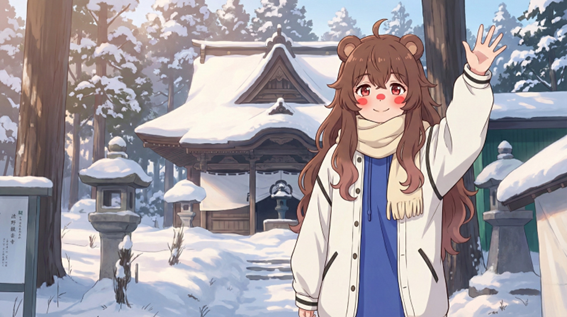
If you tour Yonezawa, the setting of the movie ‘Suki demo Kirai na Amanojaku,’ in winter, you can walk while overlaying the landscapes that appeared in the film with the actual streets. Places such as the grounds of Sasano Kannon, the area around Yonezawa Station, and Baikado are enjoyable spots where you can compare the scenery in the footage with the actual location.
The pilgrimage sites are scattered not only within Yonezawa City but also in the Kaminoyama and Murayama areas. If you have extra time, extending your visit to the surrounding areas can give you a stronger sense of the expanse of Yamagata depicted in the work.
As of February 2026, ‘Suki demo Kirai na Amanojaku’ is available for streaming on Netflix. Of course, you can plan a pilgrimage after watching it, and if you rewatch the movie after the pilgrimage, the landscapes and places that appeared may feel a bit more tangible.
![[Yamagata, Yonezawa City] Tokiwa Branch Noboru | Luxurious Yonezawa Beef Bowl! Actual Eating Report デスクトップ向け](https://bongheiberg.yamagata.jp/wp-content/uploads/2026/03/tokiwanoboru-gyudon2-1024x768.png)
![[Yamagata, Yuza Town] Spectacular View ‘Maruike-sama’ | Visiting Maruike Shrine with Its Legendary Tales! アイキャッチ](https://bongheiberg.yamagata.jp/wp-content/uploads/2026/03/top.jpeg)
![[Yamagata, Tendo City] Kosodate Mirai-kan Gen Kids|Indoor Facility You Can Play for Free – My 5-Year-Old Son Experiences ‘Challenge’ and ‘I Did It!’ アイキャッチ](https://bongheiberg.yamagata.jp/wp-content/uploads/2026/01/20260223153907_2026022315390701_20260223153907_20260223153907.png)
![[Yamagata, Obanazawa City] Ginzan Onsen | Perfect for a day Trip! A Healing Journey at a Retro-Cute Hot Spring アイキャッチ](https://bongheiberg.yamagata.jp/wp-content/uploads/2025/09/ginzan-eyecatch.jpg)
![[Yamagata, Sakegawa Village] What’s that shape? “Totoro Tree” | A Complete Guide to the Charm of Kosugi’s Great Cedar アイキャッチ](https://bongheiberg.yamagata.jp/wp-content/uploads/2025/10/202602231552361_122.jpg)
![[Yamagata, Higashine City] Enjoy the seasonal changes of Sekiyama Falls! The charm of “Otaki Drive-in Izumiya” アイキャッチ](https://bongheiberg.yamagata.jp/wp-content/uploads/2025/08/otaki_izumiya_.png)
![[Yamagata, Nagai city] Nagai Dam: A top sightseeing spot and fun activities. アイキャッチ](https://bongheiberg.yamagata.jp/wp-content/uploads/2025/07/IMG_3435-scaled.jpg)

![[Yamagata City] Actual Eating Report of Wasaman Curry Lunch at SLOWJAM – Local Blogger Sakura’s Review Report アイキャッチ](https://bongheiberg.yamagata.jp/wp-content/uploads/2026/01/chatgpt-image-2026202602231552361202602231552362220260223155236-17_31_00.png)
![[Yamagata, Tendo] Enjoy authentic gelato at the sports park! Made by Italian-trained artisans at “COZAB GELATO” アイキャッチ](https://bongheiberg.yamagata.jp/wp-content/uploads/2025/09/top-scaled.jpg)