

[Yamagata, Oe Town & Nishikawa Town] Enjoying Mt. Oatamori During the Late Snow Season|Safe Snow Mountain Hiking for Winter Beginners
2026/02/13 This site contains advertisements. Category: mountain-climbing
![[Yamagata, Oe Town & Nishikawa Town] Enjoying Mt. Oatamori During the Late Snow Season|Safe Snow Mountain Hiking for Winter Beginners アイキャッチ](https://bongheiberg.yamagata.jp/wp-content/uploads/2026/01/2026022315390723-1.png)
“I want to try winter mountain climbing, but jumping straight into a full-scale snow mountain feels a bit intimidating…” If you’ve ever felt that way, there is a mountain I highly recommend. Not in the harsh mid-winter season, but in the late-winter remaining snow season, when you can safely enjoy the atmosphere of a snowy mountain.
Daizumoriyama, one of the Yamagata 100 Famous Mountains, is located in the Nishimurayama region of Yamagata Prefecture. Its elevation is under 1,000 meters, and the trail is relatively gentle. It rarely shows a harsh face, allowing you to walk calmly through a forest wrapped in snow. You can enjoy a quiet, peaceful time while feeling just a touch of winter mountain tension—this is the unique charm of climbing during the remaining snow season.
What Kind of Mountain Is Daizumoriyama?
Daizumoriyama is a 984-meter mountain straddling Ōe Town and Nishikawa Town in Yamagata Prefecture, and is one of the “Yamagata 100 Famous Mountains.” From the summit’s observation tower, you can enjoy a 360-degree panorama of Mt. Gassan, the Asahi Mountain Range, Mt. Hayama, and Mt. Zao. The well-maintained hiking course is easy even for beginners, and the mountain is loved year-round—spring for wild vegetables, autumn for colorful foliage.
Can Beginners Climb Daizumoriyama in Winter?
During the remaining snow season, Daizumoriyama offers conditions that make it approachable even for snow-mountain beginners. Here are the physical requirements and points to keep in mind.
Required Fitness
The west route is longer, but steep climbs are few. If you can walk a snow-free low mountain for 2–3 hours and choose a day with stable weather, beginners can climb without difficulty.
Points to Watch Out For
There are no major rocky sections or technical areas, but near the ridge the snow can harden and become slippery. During the remaining snow season, watch for post-holing and poor visibility, and prepare basic gear such as snowshoes or wakan.
Recommended Season (Remaining Snow Period)
Late March to early April is ideal. Temperatures are more stable, the snow is firm and easy to walk on, and you can safely enjoy the winter mountain atmosphere.
Remaining Snow Season Climb Report
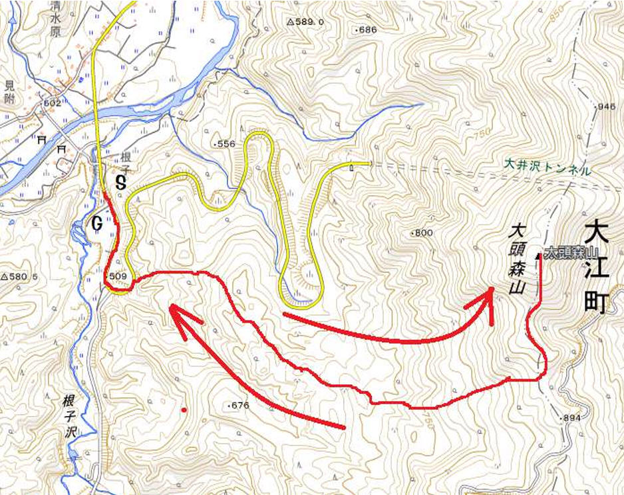
Route and Time
8:00 Daizumoriyama Trailhead → 11:15 Summit (Lunch) 11:55 → Return to Trailhead 14:10
Gear (Snowshoes and Wakan)
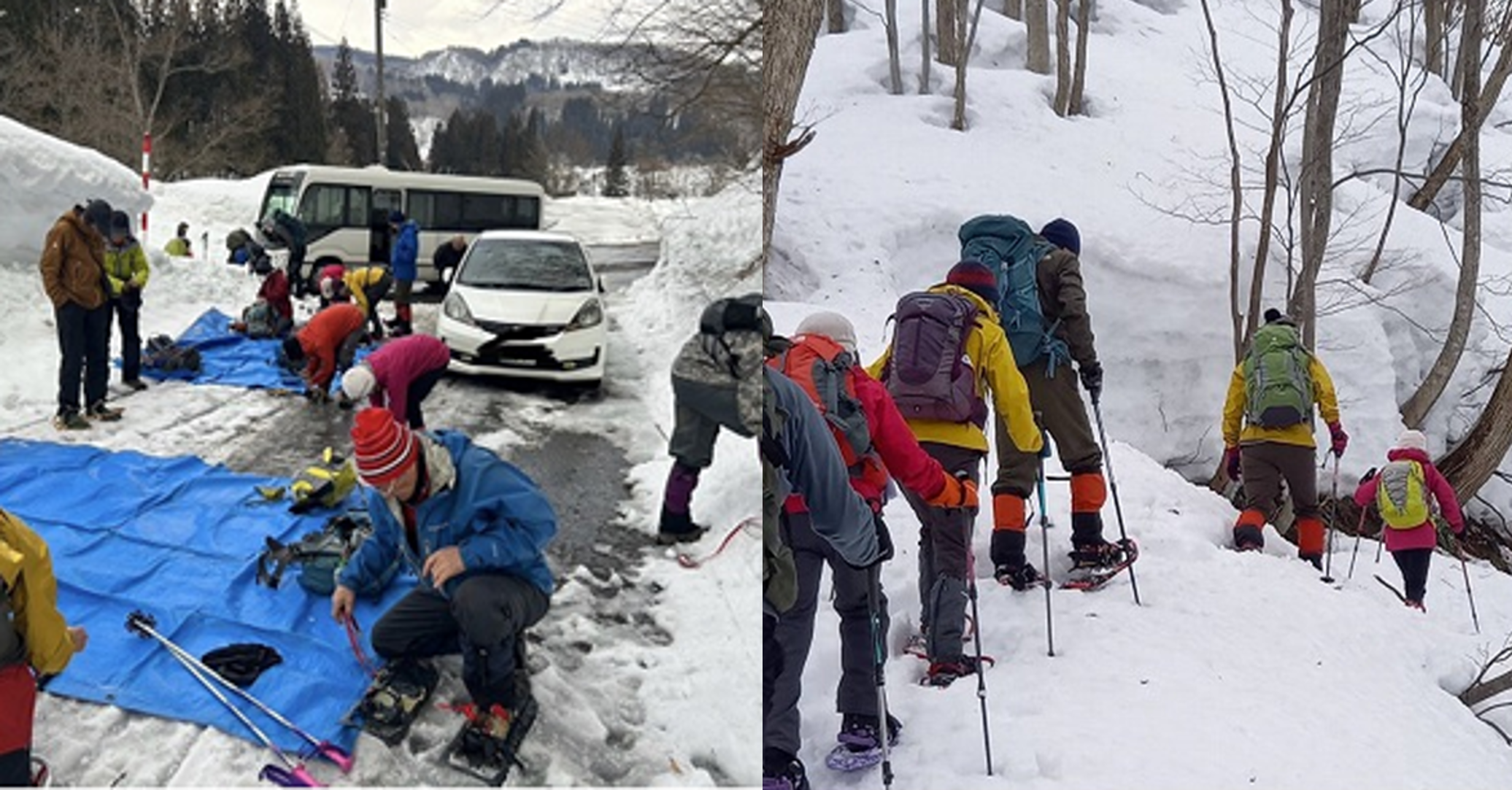
Early March. Even though the snow is firm, preventing post-holing is a basic rule of winter mountain safety. Everyone straps on snowshoes or wakan and steps into the white world.
Walking Through a Beautiful Beech Forest
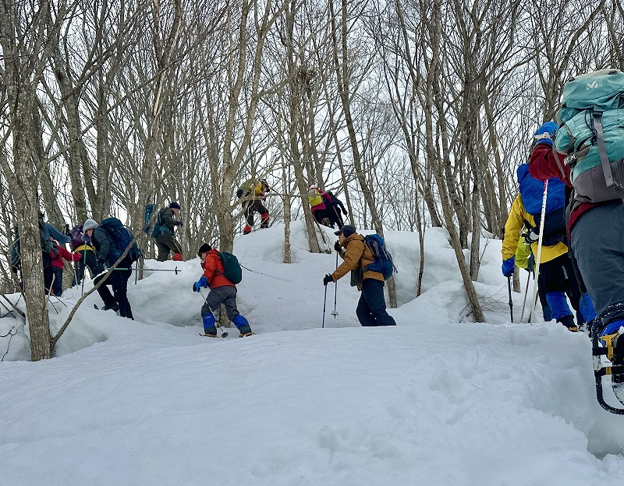
The first section winds through a beautiful beech forest. The wind passing between snow-covered trees is cold yet refreshing, and the quiet, steady steps create a luxurious moment.
“Sweat” Is the Enemy in Winter Mountains—Adjust Frequently
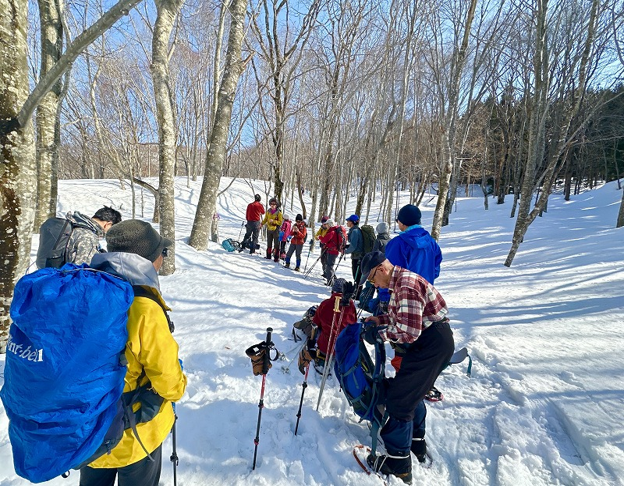
After about 30 minutes, you begin to sweat. “In winter mountains, sweat is dangerous.” To prevent sweat chill, take frequent breaks and adjust your clothing to maintain a stable body temperature.
The Summit Comes Into View—A Motivating Moment
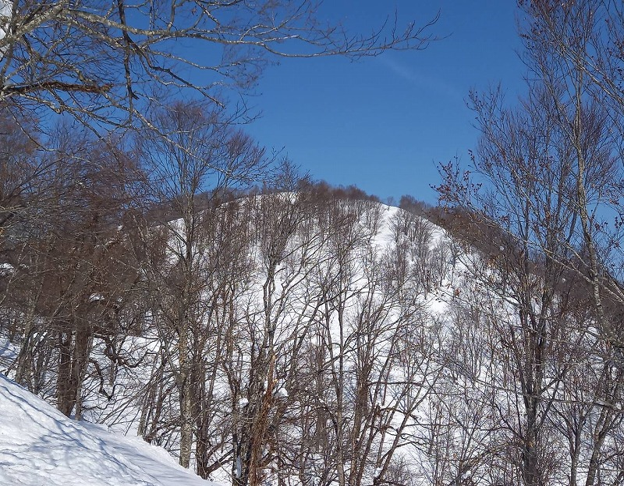
Once you reach the ridge, the summit appears. Seeing your goal clearly makes your steps naturally lighter.
Final Push to the Summit
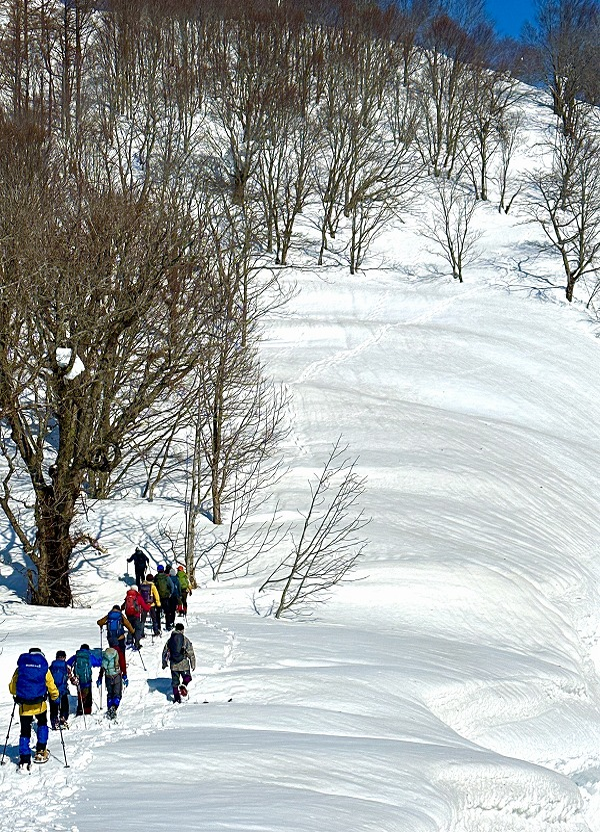
From here, you take the shortest route upward. The contrast between the blue sky and white snow heightens the excitement.
Daizumoriyama Summit: 360-Degree Panorama
Awaiting at the summit is a breathtaking view of the Asahi Range, Mt. Gassan, Mt. Hayama, and the Zao Range. It’s a panorama far beyond what you’d expect from a 984-meter mountain.
Lunch Time Bliss at the Summit
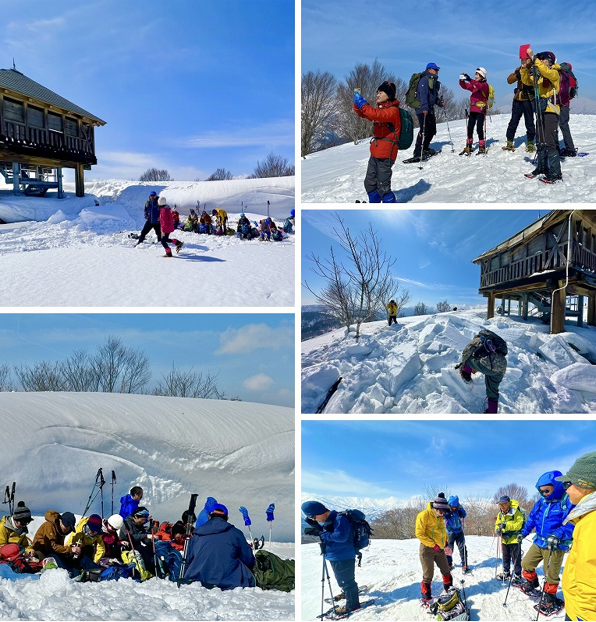
Enjoying lunch with a stunning view is the ultimate refreshment. Nearby, the emergency shelter’s roof had collapsed under heavy snow—a reminder of winter’s immense power.
Main Peak Mt. Ōasahidake Appears
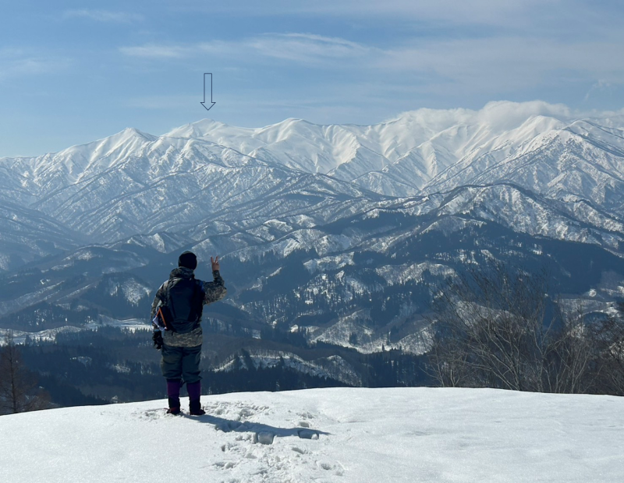
As if answering our wishes, Mt. Ōasahidake emerged from behind the clouds—its powerful presence captivating everyone.
Dreaming of the Next Peaks: Mt. Gassan and Mt. Yudonosan
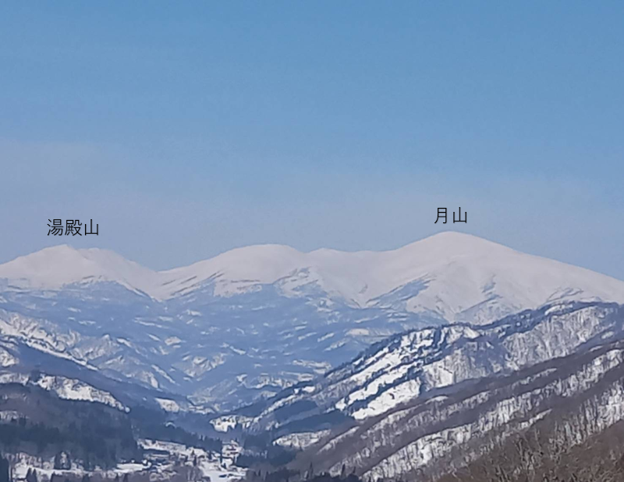
Seeing Mt. Gassan (1984m) and Mt. Yudonosan (1500m) shining in the distance sparks new goals. Yudonosan, climbable only in the snowy season, has a special allure—winter mountain curiosity never ends.
Feeling the Depth of Snow on the Descent
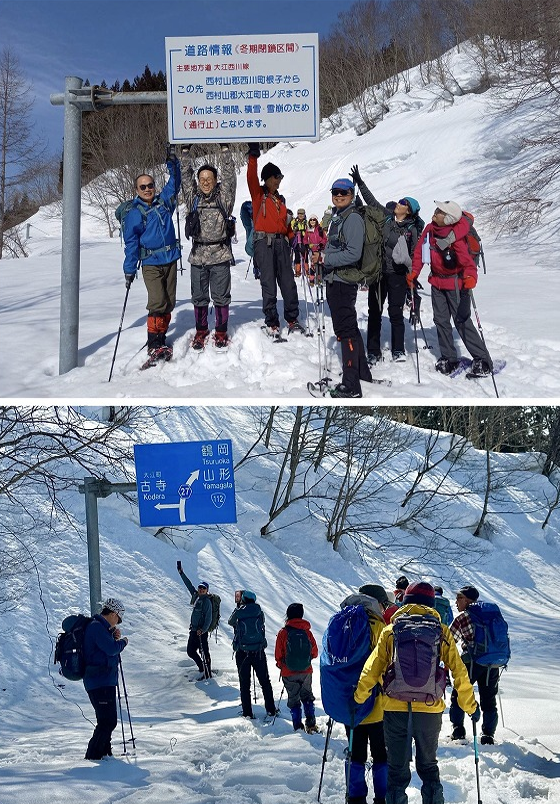
Walking back along the road, you notice a road sign that should normally be far overhead right in front of you. A striking reminder of how deep the snow truly is.
Winter Daizumoriyama: Charm and Caution Points
This time, we avoided the summer route and climbed slowly from the west side. With stable March weather and firm snow, it was an ideal winter climb. The summit’s 360-degree panorama was simply spectacular. In the snow-free season, the east trailhead offers an easy 800-meter (30-minute) climb. In the snowy season, the west side provides a full winter mountain experience with grand summit views.
Points to Keep in Mind
Although enjoyable year-round, winter conditions bring rapid changes in weather and temperature. Prepare proper gear, plan carefully, and enjoy the charm of winter mountains safely.
Summary
Daizumoriyama is the perfect step-up mountain for those interested in winter climbing but hesitant to tackle harsh mid-winter peaks. With its modest 984-meter height, the remaining snow season offers quiet snowy trails and sweeping summit views. The west route is longer but gentle, and on a stable weather day, beginners can climb calmly. At the same time, winter-specific risks like post-holing and sweat chill require proper gear and planning.
If you want to “experience a bit of winter mountain atmosphere” or “find a snow mountain for your next step,” a remaining-snow-season climb of Daizumoriyama will surely become a memorable day.
![[Yamagata, Oguni Town / Iide Town] Climbing ‘Kuratesan’ and the ‘Submerged Forest’ of Shirakawa Lake | Be amazed by the huge panorama from Kuratesan and the magical Shirakawa Lake! アイキャッチ](https://bongheiberg.yamagata.jp/wp-content/uploads/2026/05/image2.jpg)


![[Yamagata, Higashine City] Sobadokoro Higashitei|A place near the Higashine sakuranbo station where you can try cold meat soba etc アイキャッチ](https://bongheiberg.yamagata.jp/wp-content/uploads/2026/02/398e9260dd7f4f868180b280bdeb03f8-scaled.jpg)
![[Yamagata, Yonezawa City] Nationally Designated Historic Site ‘Uesugi Family Mausoleum’ | Visiting Report of a Historic Spot Where Uesugi Kenshin and Uesugi Yozan Rest アイキャッチ](https://bongheiberg.yamagata.jp/wp-content/uploads/2026/03/gobyosyo-main-1-scaled-e1773895183538.jpg)
![[Yamagata, Obanazawa City] Stewed Hormone ‘Sasanishiki Shokudo’ | I Went to a Popular Spot That Never Stops Having a Line! アイキャッチ](https://bongheiberg.yamagata.jp/wp-content/uploads/2026/02/5e784e5981a96bbb68dcfef63a84a621-scaled.jpg)
![[Yamagata, Yamagata City] Ofuro Café Yusa | Relaxing and Instagrammable Hot Springs アイキャッチ](https://bongheiberg.yamagata.jp/wp-content/uploads/2025/09/yusa_irigutisyoumen.jpg)